
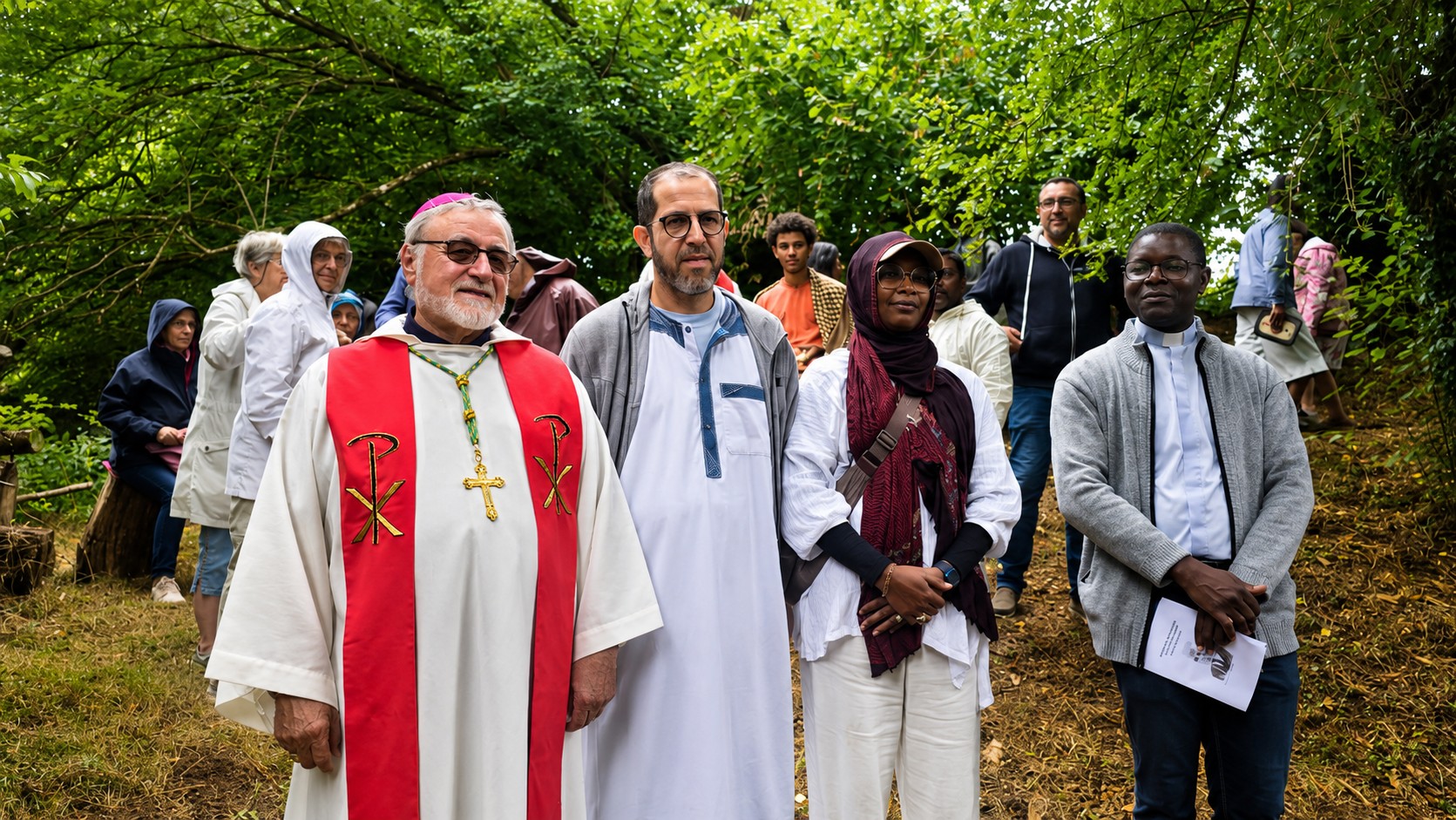
While the Society of African Missions (SMA) and the Sisters of Our Lady of Apostles (OLA) were on pilgrimage to celebrate their Triple Jubilee, Michel Cartatéguy, Archbishop Emeritus of Niamey, travelled to Brittany to preside over another significant event: the annual Islamo-Christian Pilgrimage of the Seven Sleepers at Le Vieux-Marché. At the conclusion of this gathering, he returned to Lyon to celebrate the closing Mass of the Triple Jubilee at the Basilica of Notre-Dame de Fourvière.
In her article published in Ouest-France, journalist Virginie Guennec offers readers a vivid account of the Islamo-Christian pilgrimage held at Le Vieux-Marché on 26 July. For more than seventy years, this unique gathering has brought together Christians, Muslims, and people of no religious affiliation to celebrate fraternity, peace, and mutual understanding. Held at the ancient sanctuary of the Seven Saints in Brittany’s Côtes-d’Armor region, the Pilgrimage of the Seven Sleepers has become one of France’s most enduring symbols of interreligious dialogue. Every summer, pilgrims from different regions and traditions gather for prayer, reflection, and fellowship, demonstrating that faith can be a bridge rather than a barrier.
This year’s programme began with a Eucharistic celebration in the chapel, followed by a procession to the Pillar of Peace and finally to the spring, where the Muslim participants gathered for a moment of prayer centred on Surah 18 of the Qur’an, The People of the Cave, a narrative closely related to the Christian tradition of the Seven Sleepers of Ephesus. The shared reverence for this ancient story continues to make the pilgrimage a powerful symbol of the spiritual heritage Christians and Muslims hold in common.
Building the Kingdom of God together
Presiding over the pilgrimage for the first time as its principal celebrant, Archbishop Michel Cartatéguy reminded the congregation that interreligious dialogue is not merely an exercise in courtesy but a genuine expression of faith. Drawing from the First Book of Kings, he reflected on Solomon’s encounter with God. When the Lord appeared to the young king in a dream and invited him to ask for whatever he desired, Solomon did not seek wealth or power. Instead, he prayed for a discerning heart and the wisdom to distinguish between good and evil.
The Archbishop noted that Solomon also occupies a privileged place in Islamic tradition. In the Qur’an, he is known as Sulayman, heir of David, a prophet and king whom God endowed with extraordinary wisdom and authority. For Christians and Muslims alike, Solomon embodies the virtues of justice, wisdom, and faithful service to God. This shared biblical and Qur’anic figure illustrates how both traditions possess common spiritual foundations that encourage dialogue and mutual respect.
Turning to the Gospel of the day, Archbishop Cartatéguy reflected on Jesus’ parables of the hidden treasure and the pearl of great price. At first glance, the image of treasure may suggest material wealth. Yet, he explained, the deepest treasures are often found in relationships—a loving spouse, a cherished grandchild, a faithful vocation, or a life transformed by God’s grace. He also recalled that the Qur’an uses the language of hidden treasure in a spiritual sense, suggesting that every surah and every verse contain treasures waiting to be discovered by those who seek God sincerely. For Christians, however, the greatest treasure is not an object but a Person. Christ Himself is the hidden treasure through whom God’s Kingdom becomes present in the world. The Kingdom is not merely a future heavenly reality; it is already growing quietly among us whenever people choose love instead of hatred, reconciliation instead of division, and service instead of self-interest.
A missionary experience that gives credibility
Drawing upon his many years of missionary service in Niger, Archbishop Cartatéguy spoke with deep conviction about what genuine interreligious dialogue looks like in daily life. Having spent much of his priestly and episcopal ministry in one of the world’s poorest countries, he recalled working side by side with Muslim leaders and communities to defend human dignity and serve those wounded by poverty, injustice, and political instability. “We united our spiritual and human resources,” he explained, “to restore dignity to every person whose life had been scarred by suffering.”
For him, collaboration between Christians and Muslims never required abandoning one’s religious identity. Rather, it called believers to become more faithful to their own traditions while working together in the service of humanity. This conviction led him to deliver one of the strongest messages of his homily: “A kingdom of peace can only come into being if all believers unite in the same struggle, beyond their doctrinal differences. What they share is the priceless treasure of the desire for peace and the commitment to make it flourish in human hearts.” He further recalled Pope Leo XIV’s teaching that authentic interreligious dialogue plays a decisive role in rejecting the logic of violence. Every great spiritual tradition, he said, contains within its deepest sources a message of peace that leaves no room for hatred disguised as religion.
The witness of the “Seven Sleepers”
Returning to the figures of the Seven Sleepers, Archbishop Cartatéguy invited the pilgrims to contemplate their unwavering fidelity. Their courage, rooted in profound faith, ultimately led them to martyrdom. Their witness, he said, should inspire Christians and Muslims alike to become ever more faithful to God and, consequently, more faithful to their vocation of serving humanity. In one of the most memorable moments of his homily, he described the statues of the Seven Saints through a series of symbolic gestures: Hands joined in prayer; hands placed over the heart in love; hands extended in welcome; and Hands opened in generous offering. These four gestures, he explained, summarize the vocation of every believer. “To pray, to love, to welcome, and to offer—these are the fruits of God’s Kingdom that believers are called to bear today and for generations to come.”
A pilgrimage that continues to inspire first-time participants
Virginie Guennec’s report also highlights how the pilgrimage continues to attract those taking part for the first time. Among them was Joëlle Joly, a Catholic from Creil, who travelled with members of Olivier Carré’s association. Deeply impressed by the atmosphere of fraternity, she reflected on the diversity of her own city: “In Creil, we have 140 different cultures. If we want to continue living together in peace, pilgrimages like this one need to spread everywhere.” Her sentiments were echoed by Fatiha Bendhaiba, a Muslim who travelled from Rambouillet with her husband specifically to attend the pilgrimage for the first time. Moved by what she experienced, she expressed the hope that similar initiatives would become more widespread: “We hope gatherings like this become much more common. They encourage peace between people, communities, and religions. We are tired of misconceptions and stereotypes. This morning touched me deeply, and my husband and I already plan to come back.”
A prophetic sign for our time
At a time when religious misunderstanding, social tensions, and violence continue to affect many parts of the world, the Pilgrimage of the Seven Sleepers remains a prophetic witness to another way of living together. For more than seven decades, it has shown that Christians and Muslims can walk side by side, pray according to their respective traditions, and work together for the common good without compromising their faith.
Archbishop Michel Cartatéguy’s homily reaffirmed that authentic dialogue begins not by minimizing differences but by recognizing the shared call to seek God, uphold human dignity, and build a Kingdom marked by justice, peace, and love. The pilgrimage continues to remind believers that true faith bears visible fruit: prayer, love, hospitality, generosity, and a steadfast commitment to peace. These are the enduring treasures entrusted to all who seek to build bridges in a divided world.

Leave a Reply