
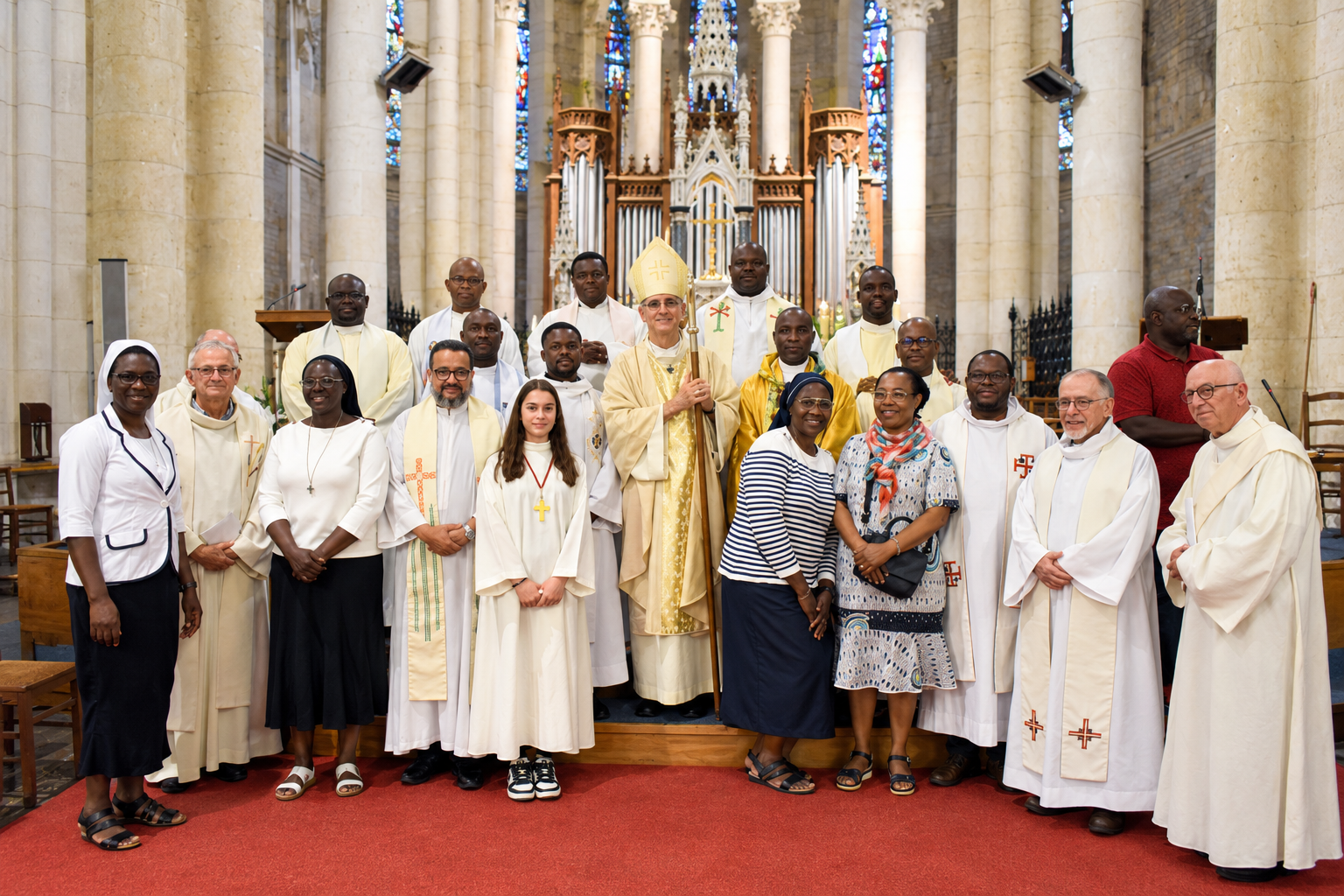
NANTES, France — September 19, 2026 — In a celebration marking both a new beginning and the culmination of years of inter-congregational collaboration, Fr. Yves Tchogli Koffi Tognisse was installed as parish priest of Saint-Barthélemy-entre-Loire-et-Divatte in the Diocese of Nantes. He did not arrive alone. Fr. Emmanuel Ambi and Fr. Aloïs Kituba were installed as vicars, and a community of four Sisters of Our Lady of Apostles (OLA) is set to join them in the coming months. Bishop Laurent Percerou of Nantes presided over the installation Mass, witnessed by SMA confreres, OLA sisters, diocesan clergy, and lay faithful.
Collaboration Rooted in History and Theology
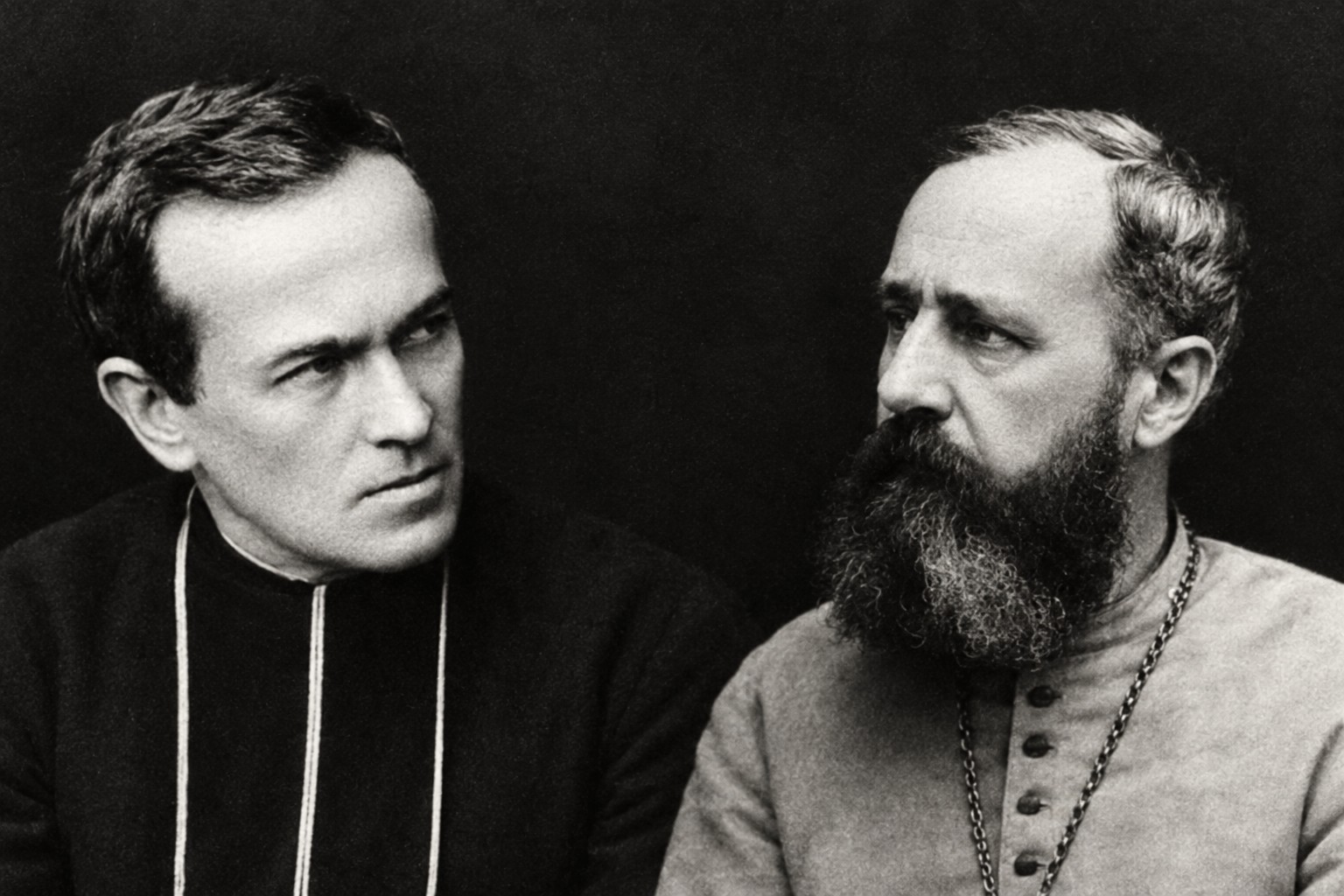
The SMA-OLA collaboration now visible in Nantes reaches back to the founding charism of both congregations. As early as October 1856, before either congregation had fully taken shape, Bishop de Brésillac wrote of his hope to “prepare from a distance a common action” with women religious. Fr. Augustine Planque, who carried the founders’ vision forward, was equally explicit: Church planting in Africa — encompassing health, education, and evangelization — was inconceivable without the participation of sisters. Collaboration was not Plan B. It was the plan.
That founding intuition received fresh articulation during a session of the Triple Jubilee celebrations on June 2, 2026, in Lagos, Nigeria, reported by Pierre-Paul Dossekpli. Sr. Mary T. Barron, Superior General of the OLA, opened with a reflection titled The Call to Collaboration as a Call to Mission. Her argument was not that collaboration is useful or necessary, but that mission, rightly understood, cannot be anything other than collaborative. Grounding her reflection in the Missio Dei, she insisted that mission originates not with us but with God, who is relational at the core. If mission is participation in the Trinitarian life, then a solitary, self-sufficient approach to mission is not merely inefficient — it is a contradiction in terms.
Sr. Mary moved beyond the language of complementarity — which can imply two self-contained entities filling each other’s gaps — toward reciprocity: the recognition that SMA and OLA “carry the same charism in different bodies, histories, and expressions, and that each enriches the other.” She outlined five conditions for this to become reality: a shared understanding of co-responsibility; a spirituality of mutual listening; the courage to share and bestow power across hierarchies and cultures; intercultural competence as a synodal skill; and a shared narrative of mission — because, as she put it, “if we narrate mission separately, we will act separately.”
Fr. François du Penhoat, Superior General of the SMA, provided the historical argument. His presentation, Moving Forward Together — SMA and OLA at the Service of the Kingdom, showed that relational mission is not a modern ideal grafted onto the two congregations but their original design. He also named honestly the difficulties that have marked SMA-OLA relations over generations: lack of respect for autonomy, financial misunderstandings, prejudice, and the recurring tendency for one side to “set a train in motion and ask the other to hitch their wagon to it.” Against these shadows, he set testimonies of genuine collaboration in Bariba land in northern Benin and at Vaulx-en-Velin in France, where a contract was signed jointly with the Archbishop and where fathers and sisters worked, prayed, and shared life. What emerged, he said, was “converting together” — a mutual belonging in which OLA sisters are genuinely “our sisters,” not external partners.
The remaining question is whether SMA and OLA members will live accordingly. That requires cultural transformation: a patient uncovering of the assumptions, habits, and power dynamics that quietly shape how the two institutes actually relate.
The Installation: The Bishop’s Homily
Bishop Percerou began his homily by reflecting on the parable of the workers sent to the vineyard. The setting was providential, he noted, because the parish lies in the doyenné du vignoble. “This word, ‘Go also to my vineyard,’ particularly reaches us this evening,” he said, “because a parish priest is fundamentally a man whom the Lord sends to his vineyard, to your vineyard.”
Addressing Fr. Yves directly, the bishop emphasized that he does not arrive alone. He is accompanied by Fr. Emmanuel Ambi and Fr. Aloïs Kituba, and in a few months by the OLA sisters, whose mission is merged into the same mission. “You are called to live together a mission lived in fraternity,” the bishop said. “You are three priests with your histories, your sensitivities, your journeys, your experiences, your different riches, and as a team under your responsibility, you are sent toward the same people and in the service of the same Lord.”
The bishop stressed that in the Church no one is ever sent alone. Even when a priest receives a personal responsibility, he remains a brother among brothers and sisters. The parish priest is not the one who does everything. He is the one who gathers, encourages, listens, celebrates the sacraments, prays with his people, and discerns with them the paths for mission. Above all, his mission is to help each person discover the place the Lord gives them in his vineyard. “The vineyard is not that of the parish priest; it is that of the Lord. He is only the steward.”
That truth, Bishop Percerou added, applies to the faithful as well. “This parish is not your property; it is entrusted to you.” It is entrusted to Fr. Yves, Fr. Emmanuel, and Fr. Aloïs; to the OLA community that will soon join them; and to all who live their baptism there — those who have been present for a long time and those who have just arrived, those who are deeply engaged and those still seeking their place. To all of them, the Lord says: “You too, come to my vineyard.”
The bishop acknowledged that a new curé will disrupt habits. Fr. Serge had been with the parish for nine years, and a new parish priest will be shaped in turn by a parish that does not resemble the one he knew before. The community is called to leave its habits and go out to meet those who are far away. “Look at the Gospel,” the bishop said. “The master does not stay in his house, well sheltered behind his walls; he goes out; he goes out several times. He goes to seek workers where they are.” This is a magnificent image of the missionary Church.
To Fr. Yves, Fr. Emmanuel, Fr. Aloïs, and the OLA sisters, the bishop said: “The parishioners need your faith, your prayer, your gaze, and your missionary experience.” Who better than you can remind them that the Church is larger than their habits, larger than the borders of their parish, even larger than the borders of our Diocese of Nantes and of our Church in France?” But he added that they will also need the parishioners. The faithful will ask much of them, surprise them, question them, share their worries — and, the bishop hoped, their joy, their projects, and their hopes. Priests are not sent to work in place of others but with others, to guide and orient their work.
The bishop thanked the pastoral coordinator, the members of the pastoral animation team, and all who serve the parish. He then issued a challenge: “If this year you could say: ‘Our mission is this: to make resound the Lord’s call, “You too, come to my vineyard”‘” — to the one who has just arrived, to the catechumen or neophyte, to the young person, to the one who thinks he has no place, to the one who arrives at the last hour — because it rejoices the master of the vineyard.” The true salary, he said, is not a merit-based reward but the joy of seeing others discover that they are loved by God in Jesus Christ. “That will be your salary.”
He concluded: “Yves, Emmanuel, Aloïs, and you too, my sisters, here is the people the Church entrusts to you. Love them. You receive men and women, but you receive brothers and sisters to serve and with whom you must now walk. And you, brothers and sisters, do not let your priests carry the mission alone. Pray for one another. Forgive one another when necessary. Encourage one another when you are tired. Rejoice together when something beautiful is born among you. Keep your eyes turned toward Christ who gathers you, for he is the master, the only master of the vineyard.”
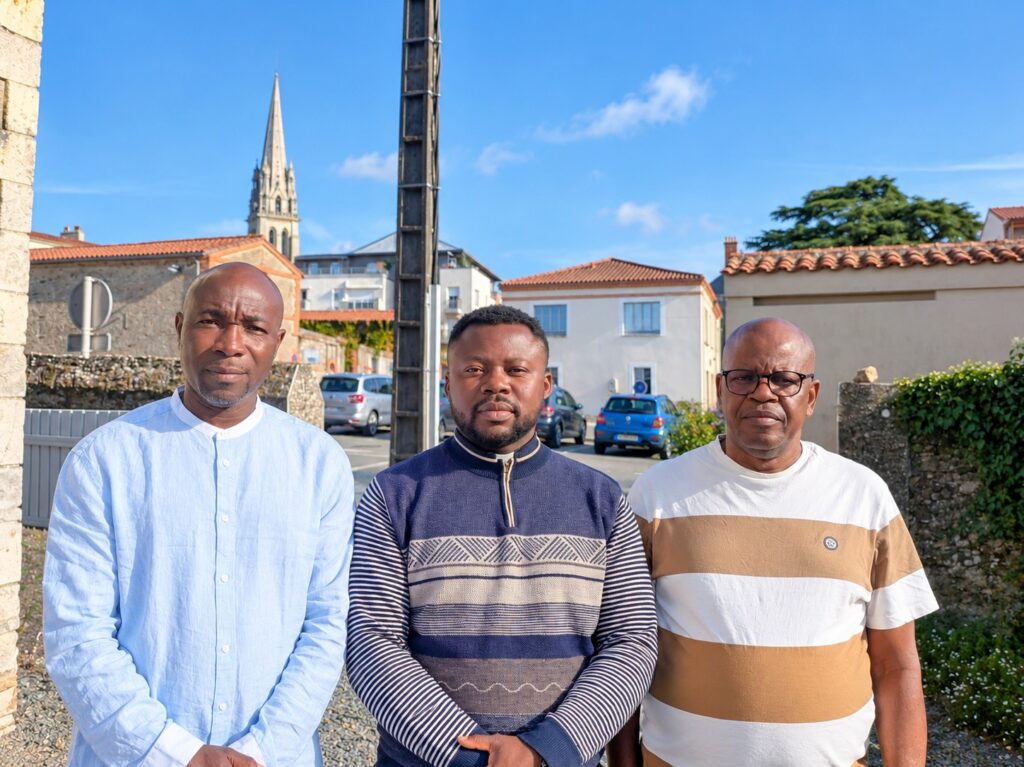
Left, Fr. Yves Tchogli, Fr. Emmanuel Ambi (Centre), and Fr. Alois Kituba (right).
Voices from the Celebration
Fr. Yves Tchogli Koffi Tognisse, the new parish priest and a member of the SMA Lyon Provincial Council, expressed gratitude: “I give thanks to God for this installation. It is truly a great mission that has been entrusted to our missionary family, Brésillac-Planque, here in France, between the SMA and the OLA. To collaborate also with the laity, since synodality is where we broaden, where the pope truly asks us to walk together — it is a great challenge for all of us, for us priests and for my collaborators, Fr. Aloïs and Fr. Ambi, plus the four sisters who come under the parish, especially with Sr. Suzanne Yeboua, who will be the pastoral coordinator. Diversity is a chance. With the grace of God, we can truly walk together to form and grow as a family.”
Fr. Aloïs Kituba emphasized fraternity: “Since we arrived, we have insisted on one theme: fraternity. Try to create unity. If we are one in our way of thinking and acting, we will succeed in meeting the challenges of the mission we have at Saint-Barthélemy.”
Fr. Emmanuel Ambi shared his first impressions: “The faithful here have welcomed us well, and we have already begun to meet them. For me, this is a moment of learning — to go toward people, to listen to them, and to share the Christian faith with them. I hope everything will work well and that we will collaborate well, and that the spirit of our founder will animate us to work as brothers in fraternity with one another.”
Sr. Suzanne Yeboua, a member of the OLA Provincial Council and the new pastoral coordinator, spoke of the significance of the mission: “For us, this mission is truly to respond to today’s solicitation — the mission in the periphery. This is not a periphery of working-class neighborhoods, but a geographic periphery. The mission in the lands is very important for us, and we believe we are truly responding to a demand of the Church’s mission going forth. To live also this mission in collaboration is a missionary project that has matured and is seeing the light of day. We place ourselves under the gaze of Our Lady of the Apostles so that this mission truly bears fruit, as our bishop says, ‘Go also to my vineyard.’”
The Diocese and the Provincials
In an interview, Bishop Laurent Percerou explained his main message to the new team: “The main message would simply be that the priests sent to this parish love their people. A good priest, a good shepherd, is one who loves Christ and who loves the men and women to whom he is sent, and who seeks to love them in the way he himself is loved by Christ. From there, normally, everything goes well — the faithful are confident when they feel loved, and the priests are happy in their ministry because the faithful return the love they give them, which is none other than the love of God.”
The bishop noted the richness of having a second SMA community in the diocese, in two very different parishes: one a popular parish on the outskirts of Nantes, the other a more rural parish close to Nantes but with a distinct reality. “Welcoming a missionary community is first of all helping our Church in these years to be missionary,” he said. “And being able to welcome priests from other cultures, formed for mission, allows our diocese to open itself to the universality of the Church.”
He added: “We live in societies today in the West that tend to withdraw into themselves because of economic difficulties and a difficult political context. That we, the Church, can show the sign of a universal, intercultural Church, open to difference and capable of reconciling our differences — that is a beautiful sign of fraternity. That is also what I expect through the SMA communities welcomed here.”
The bishop also highlighted the SMA’s practical support for “Fidei Donum” priests from West Africa and French-speaking Africa, who sometimes struggle to adapt. “We need your know-how, your talent, your formation to help all these brother priests find their place in the diocese.”
On the specific SMA-OLA collaboration, Bishop Percerou said: “What is at stake is the complementarity of vocations — between the religious vocation and the priestly ministry, and between man and woman, which allows for enrichment, greater availability, and better discernment of situations. This is an interesting experience that we will follow closely.” He also called on the laity not to withdraw: “I launched an appeal to parishioners, saying: it is not because you have three priests and a community of religious sisters that you must now withdraw from your commitments, saying to yourselves, ‘There are people.’ What I also expect from the religious sisters is that they accompany and help the laity to take their place in the mission of the parish.”
Sr. Victoria Zira, Provincial Leader of the OLA in France, added: “This mission is a very important call for the OLA. We have spoken a lot about collaboration with the SMA — collaboration in the concrete. It is a way of showing that good collaboration is possible. In Lagos, we spoke a lot about this with the two bodies. Today, it is a joy to see that the Diocese of Nantes trusts us. The diocese trusts us because it believes that together we can go further in collaboration. I know that our sisters and the fathers will work well together in this rural environment where there is a real need. My prayer is that this collaboration goes further, and that the Church and the people of God both benefit from it.”
Fr. Augustin Placide Houessinon, Lyon Provincial Superior, gave thanks for the installation and outlined his hopes: “This makes visible the collaboration for which we have walked since 2016. It reached its culmination at the Plenary Council in Nigeria. We say thank you to the Lord for giving us this occasion, so that this becomes reality.” He acknowledged the challenge: “The challenge of challenges is this: to announce Jesus Christ and to make this community missionary. And also to work with the communities so that they themselves become the actors of their community.” He concluded: “With the Provincial Council of the Province of Lyon and the Provincial Council of the OLA Sisters, together we will continue this walk to accompany the confreres and sisters so that this mission truly bears witness to our presence in France and announces Jesus Christ to all men and women.”
The Lay Faithful’s Response
Delphine, pastoral coordinator of the parish, said: “We are very happy to welcome Fr. Yves, Fr. Emmanuel, and Fr. Aloïs of the Society of African Missions. A new impetus for our parish, with these missionary priests. The laity already have a strong place and a strong involvement. We hope the collaboration with our new priests and the new curé will go wonderfully. We welcome them, and the occasion will be for us to try to reach people on the peripheries of our parish, people we perhaps see less often in our churches, by being a welcoming, warm, and fraternal parish.”
Virginie, a member of the pastoral animation team, added: “We are delighted to welcome Fr. Aloïs, Fr. Emmanuel, and Fr. Yves, as well as the religious sisters who will soon arrive once they have found a nice home. We are truly very blessed, and we hope we will be able to do great things together.“
Pascal Chantro, parish treasurer, said: “On behalf of the economic affairs team, we are very happy to welcome this new team of priests, composed of three priests of the Society of African Missions. They will bring us more priestly presence in our parish.“
The Journey of the Three SMA Fathers
The three priests now forming the SMA team at Saint-Barthélemy bring different missionary journeys to the parish. Fr. Yves Tchogli Koffi Tognisse, a Togolese SMA missionary, worked for five years in Ivory Coast before coming to France in 2018. In France he has served in a number of missionary and formation-related responsibilities. He was Rector of the SMA community at Les Cartières in Chaponost, where he was involved in welcoming groups, missionary animation, and intercultural initiatives. In 2025 he also served as a member of the Lyon Provincial Council. He has now been appointed parish priest of Saint-Barthélemy-entre-Loire-et-Divatte.
Fr. Aloïs Kituba, from the Democratic Republic of Congo, was ordained in 2000 and has exercised responsibilities in the SMA mission in Congo, including leadership of the SMA community in Kinshasa. He later served in France and became known within the SMA community for his pastoral and missionary engagement. In Lyon, he was also entrusted with the ministry of exorcist by the Archdiocese in 2022.
Fr. Emmanuel Ambi, from Nigeria, was ordained to the priesthood on June 30, 2018. Shortly afterwards, he received his first missionary appointment to the SMA mission at Pisa in the Kontagora Vicariate, Nigeria. In 2026, he was appointed by the Diocese of Nantes as a cooperator at Saint-Barthélemy-entre-Loire-et-Divatte.
Their present assignment brings together three different missionary journeys within one pastoral team. Alongside the forthcoming arrival of the four OLA sisters, their task is not simply to provide additional clergy but to help build a community in which priests, religious, and lay people discover anew that the vineyard belongs to the Lord and that everyone has a place in it.
At the heart of the bishop’s homily was the same invitation addressed to the whole parish: “You too, go into my vineyard.” For Saint-Barthélemy, the new chapter begins with three missionaries, soon joined by four sisters, but its deeper purpose is for the whole parish to become missionary.

Leave a Reply