


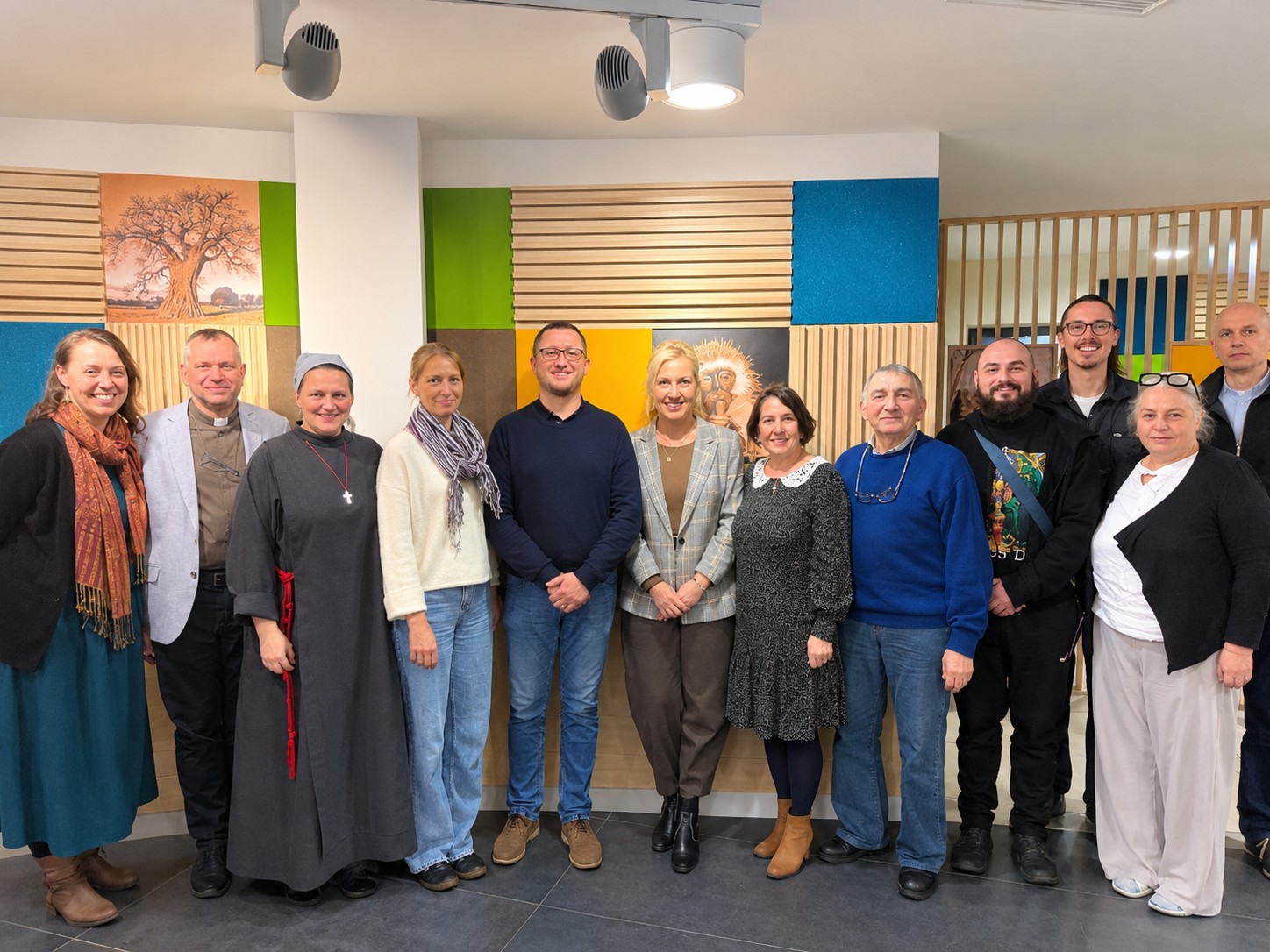
“Mission is not tourism.” This was one of the central messages of a missionary formation workshop organised in Poland by the Society of African Missions (SMA). Held from 6 to 8 November 2026 at the SMA Centre, adjoining the Polish Provincial House, the gathering brought together experienced lay missionaries, young people discerning a missionary vocation and others seeking to put their professional skills at the service of the Church. Through formation, personal testimonies and encounters, participants were reminded that missionary commitment is not simply about going somewhere to help people, but about sharing faith, building relationships and allowing oneself to be transformed in the process.
What makes someone leave the familiarity and comfort of home to serve people in another country? Why would a young professional exchange career ambitions and personal security for the uncertainties of missionary life? And what distinguishes Christian mission from humanitarian assistance?
These questions were at the heart of a weekend gathering in Poland, where participants explored the meaning of lay missionary engagement and the importance of spiritual preparation for missionary service.
The workshop, part of a longstanding SMA tradition in Poland, was coordinated under the responsibility of Fr Łukasz and provided an opportunity for both prospective and experienced missionaries to deepen their understanding of mission. It also offered a space for sharing experiences, strengthening relationships and discovering the different ways in which laypeople can participate in the missionary vocation of the Church.
Mission is an encounter, not tourism
Speaking about the purpose of the gathering, Fr Łukasz Kobielus explained that missionary formation must go beyond acquiring practical knowledge. Those preparing for mission need to understand the people they will encounter, their cultures, languages, traditions and ways of life.
“Mission is not tourism,” he emphasised, pointing out that genuine missionary commitment requires openness and a willingness to be formed by the experience of encounter.
He also challenged participants to examine their own assumptions, prejudices and fears. People arriving in a new missionary setting often carry preconceived ideas about the place and its inhabitants. Formation helps them distinguish these assumptions from reality and approach other cultures with humility and respect.
For Fr Łukasz, mission is also fundamentally a community experience. Lay missionaries, priests, religious and local communities are not simply people working alongside one another; they are brothers and sisters sharing a common faith and missionary purpose, even though their responsibilities and ways of engagement may differ.
This understanding was reflected in the contributions of missionaries who have already served in Africa, particularly in Tanzania, and in those still discerning where their talents might be most useful.
From giving to receiving: the experience of a lay missionary
Among those sharing their experiences was Katarzyna Jurdziak, who has served as a lay missionary for six years, including four years in the Netherlands and two years in Tanzania.
For her, missionary workshops are not only opportunities to acquire knowledge but also moments of spiritual renewal, community building and a deeper attachment to mission. Reflecting on her experience, she insisted that missionary service is never a one-way relationship.
“We are growing together,” she explained. “It is not simply that I go on mission or support mission by giving something. I receive much more than I give.”
Her experience in Tanzania taught her to appreciate the richness of local Christian communities and the different ways people live their faith. She was particularly struck by the hospitality and openness of the people, who welcomed her not simply as a foreign volunteer but increasingly as one of their own.
She also observed that the presence of lay missionaries can offer a valuable witness to local communities. It helps people recognise that missionary responsibility is not reserved for priests and religious. Lay Christians, too, can pray, serve their neighbours and participate actively in the Church’s mission.
However, collaboration requires openness on both sides. While some priests readily recognise the contribution lay missionaries can make in parish life, catechesis and pastoral activities, others remain less accustomed to this form of cooperation.
Katarzyna also called for stronger collaboration between lay missionaries across European SMA Units. Such cooperation, she suggested, could help connect people with particular professional skills to missionary communities that need them. Sometimes candidates are available, but the places where their services are needed are not sufficiently known.
A carpenter discovering a new direction
For Jakub Sekowski, a 39-year-old professional carpenter from Poland, the workshop represented an important turning point in a journey that had been developing for many years.
He explained that the desire to serve as a missionary had accompanied him for a long time. This was already his third attempt to take the step. On two previous occasions, difficulties had caused him to abandon the idea. This time, however, he felt more mature in his faith and more determined to respond.
For many years, he had focused on professional advancement, money and personal ambitions. Gradually, his priorities changed. Rather than asking what he wanted to make of his life, he began asking what God wanted of him.
That change, he explained, had brought him greater happiness than pursuing his own plans.
His search for a missionary organisation had not been straightforward. After finding a list of Church-recognised missionary organisations on an official ecclesiastical website, he sent approximately twenty emails explaining his background, professional skills and desire to serve. Some organisations considered him too old, while others suggested that he had missed their recruitment period. The SMA responded positively and invited him to take part in the workshop.
The experience strengthened his conviction that missionary service was no longer simply an idea but a concrete possibility. He also expressed interest in learning Swahili as part of his preparation for a possible mission.
His testimony was particularly striking in a European context where, as he observed, visible participation in Church life has declined. He believes that the pursuit of material comfort can make people reluctant to embrace demanding commitments.
For Jakub, faith is not about choosing what is comfortable, but about having the courage to respond when one recognises God’s call.
Beyond humanitarian projects: discovering the spiritual foundation of mission
Another participant, Nicholas Zawłocki, an optometrist completing his final university requirements in Poland, brought a different but equally significant perspective.
His interest in mission dates back to childhood. Growing up in a small Polish town where Capuchin Franciscans had missionary connections with Gabon and the Central African Republic, he became familiar with missionary stories from an early age.
He had already travelled to Africa twice. His first experience was in Tanzania, where he visited gold-mining communities. During his second visit, he participated in an eye-screening initiative. Although the project enabled him to help people, he returned home discouraged by the many administrative and institutional obstacles he encountered.
Having tried to carry out much of the initiative independently, he began questioning whether the time, money and energy invested were truly reaching those who needed assistance. He also felt that something essential was missing.
His encounter with the SMA missionary community helped him understand that humanitarian assistance, valuable as it is, cannot by itself express the full meaning of Christian mission.
The workshop introduced him to missionaries whose work was rooted in prayer, community life and a shared spiritual commitment. This helped him rediscover what he had been seeking.
Reflecting on his experience, he recalled the advice given at the beginning of the workshop: prayer and God must remain the foundation of missionary engagement. Practical assistance and professional expertise follow from that foundation.
Nicholas also spoke openly about his personal journey towards faith. He recalled periods when he pursued sporting success, travel and other personal ambitions, believing that each new achievement would bring lasting happiness. Yet, even after reaching some of his goals, he continued to experience an inner emptiness.
His return to a more committed Christian life, prayer and a simpler way of living gradually gave him a deeper sense of fulfilment. For him, mission is therefore not simply an opportunity to do good things, but a response to God’s love and an invitation to share that love with others.
He left the workshop encouraged to consider returning to Africa, this time with a clearer understanding of the spiritual foundation needed for missionary service.
Supporting Christians in difficult circumstances
Beyond the formation of prospective missionaries, the weekend also turned attention to Christians experiencing persecution and hardship in different parts of the world.
A contribution from Open Doors, an organisation supporting persecuted Christians internationally, helped participants understand the realities faced by communities whose freedom to practise their faith is restricted.
For some participants, the testimonies were difficult to hear, but they also offered an opportunity to reflect on how Christians living in more stable environments can support those facing persecution.
Prayer emerged as one of the most immediate and meaningful responses. Participants were encouraged to write personal messages and prayers that could be shared with Christians living in difficult circumstances, reminding them that they are not forgotten or alone.
The workshop also highlighted the importance of solidarity with missionaries already serving far from home. A simple message, a word of encouragement or the assurance of someone’s prayers can make a significant difference, particularly during periods of isolation and difficulty.
SMA Solidarity: keeping the doors open to lay missionary engagement
The initiative also offered an opportunity to reflect on the wider role of SMA Solidarity in Poland, an organisation established nearly 25 years ago in response to the growing desire of laypeople to participate in the missionary work of the Society.
At the time, many people wanted to join the SMA mission but were neither priests nor religious. SMA Solidarity was created to provide them with a space for engagement, formation and accompaniment, while also supporting missionary projects and seeking the resources needed to sustain them.
Over the years, the organisation has accompanied lay missionaries and volunteers, offering opportunities to serve in places where SMA confreres are present. While earlier engagements sometimes involved shorter projects, many current missionary placements require a commitment of at least one year.
Fr Łukasz acknowledged that the work comes with challenges. Opportunities for funding have changed, the needs of missionary communities have evolved, and younger generations have different expectations and ways of engaging.
He noted that participation in missionary formation workshops has also declined, from around 30–35 people in previous years to approximately 16 today. This raises questions about how to renew enthusiasm for lay missionary service.
One response, he believes, is to make greater use of digital communication and social media to reach young people, while continuing to welcome everyone who expresses an interest in mission, even when the number of candidates is small.
He also stressed the importance of remaining faithful to the Christian foundation of missionary engagement. SMA Solidarity is not simply a channel for recruiting people for charitable or social projects. Its purpose is to help people discover a missionary commitment rooted in faith, community and the person of Jesus Christ.
A mission that transforms both those who go and those who welcome them
As the workshop drew to a close on Sunday, participants were left with more than practical information about possible missionary destinations. They had encountered different missionary experiences, heard personal stories of discernment and recognised the importance of preparation, spiritual accompaniment and collaboration.
The testimonies of Jakub, Nicholas and Katarzyna revealed three different stages of the missionary journey: the search for a vocation, the struggle to understand the deeper meaning of service, and the experience of discovering that mission is a mutual gift.
For Fr Łukasz, the challenge is to keep creating opportunities for encounter, formation and discernment. Not everyone will follow the same path or be called to the same commitment. The important thing is to listen, accompany and help each person discover how best to respond to God’s invitation.
Ultimately, missionary engagement is not measured simply by the number of people sent abroad or the projects completed. It is about building relationships, sharing faith, recognising the dignity of others and allowing the Gospel to transform both those who go and those who welcome them.
Mission does not begin when someone boards a plane for Africa. It begins when a person opens their heart to God’s call and becomes willing to share their life, talents and faith with others.
Leave a Reply