


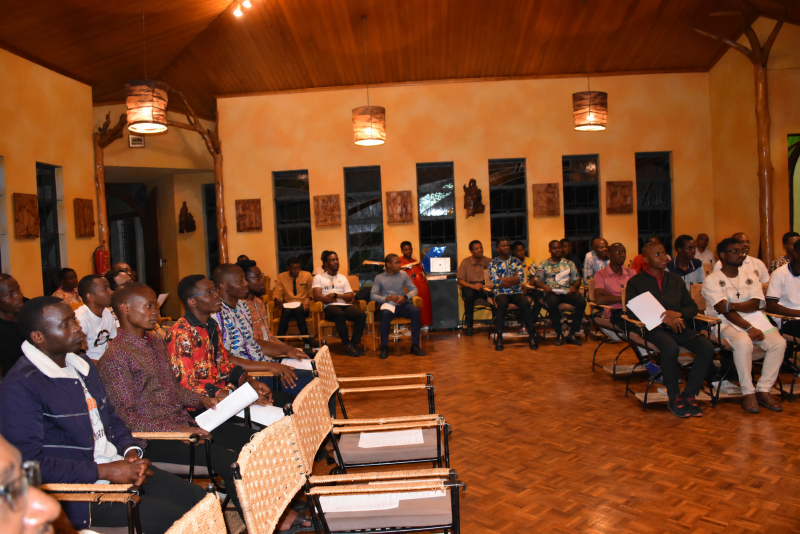
An online formation session grounded in listening invited future missionaries to reflect on how digital habits shape their attention, relationships, and availability for mission.
By Pierre-Paul Anani Dossekpli
“How are our digital habits shaping the missionaries we are becoming?” This question was at the heart of an online formation session held on 6 November 2026 for 48 seminarians of the Society of African Missions (SMA) in Nairobi, Kenya.
Entitled “From Digital Habits to Intentional Living: Media, Time and the Formation of a Future Priest,” the session explored the opportunities and challenges of digital technology in the human, spiritual, intellectual, community and pastoral formation of future missionaries.
Rather than presenting smartphones and social media simply as distractions, the session invited participants to consider a more fundamental question: how can technology serve their vocation without gradually taking control of their time and attention?
Listening Before Forming
One distinctive aspect of the initiative was the decision to begin by listening to the seminarians themselves.
Before the session, an anonymous questionnaire was distributed to understand their digital habits, experiences and challenges. Forty of the 48 seminarians responded.
The findings revealed that digital media already plays an important role in their formation. Ninety percent reported using digital platforms for academic study and research, 87.5% for communicating with family and friends, and 60% for prayer and spiritual formation.
At the same time, 87.5% acknowledged spending more time online than initially intended, at least occasionally.
These findings highlight a reality often overlooked in discussions about young people and technology: digital media is neither exclusively a problem nor automatically a solution. It offers genuine opportunities for learning, communication and spiritual growth, while requiring discernment and self-discipline.
This perspective resonates with Pope Leo XIV’s encyclical Magnifica Humanitas, which observes that technology, when guided by wisdom, “can become an instrument of growth, justice and fraternity” (no. 180).
The challenge, therefore, is not simply to reduce screen time but to ensure that technology contributes to integral human development. As one reflection on the digital age reminds us, “We do not live ‘in front of’ technology, but ‘within’ digital environments that establish forms of experience.” Indeed, digital technologies are no longer merely tools we use; they are increasingly part of the environments in which we study, communicate, seek recognition, make decisions and understand ourselves. For future missionaries, this raises an important question: How are these digital environments shaping their attention, relationships and the kind of persons they are becoming?
From Digital Habits to Intentional Living
Building on the survey findings, the session examined how digital habits influence attention, concentration, relationships and personal freedom.
Particular emphasis was placed on the relationship between attention and listening. For a future missionary, the ability to listen attentively to God, confreres and the people entrusted to his pastoral care is essential.
Constant digital interruptions can gradually weaken this capacity for sustained attention.
Drawing on biblical reflections, including 1 Corinthians 6:12, Ephesians 5:15–16 and Luke 5:16, participants were encouraged to reflect on freedom, responsible use of time and the importance of silence and prayer.
The session also introduced practical tools for daily life.
The Eisenhower Matrix helped participants distinguish between urgent and important activities, while the 4P method — Purpose, Period, Prudence and Presence — offered a simple framework for intentional digital use.
Concrete strategies included managing notifications, setting application limits, activating Focus mode and protecting dedicated periods for study, prayer and community life.
Interactive Wooclap activities encouraged participants to examine everyday situations and identify realistic changes.
From Reflection to Personal Commitment
The session concluded by inviting each seminarian to identify one practical change to implement over the following seven days.
A post-session evaluation, completed by 31 participants, provided encouraging feedback. Twenty-nine (29) respondents considered the formation very relevant to their lives as future SMA missionary priests.
The Eisenhower Matrix and the 4P method emerged as the most appreciated elements, highlighting the value of practical approaches that participants could integrate into their daily routines.
Several seminarians expressed their intention to manage their time more carefully, reduce unnecessary smartphone use, protect study periods, and exercise greater prudence before sharing information online.
One participant summarized his intended change in a simple but meaningful commitment: “Always think before I click.”
These responses suggest a willingness to move from awareness to action, although the longer-term impact of these commitments remains to be assessed.
Preparing Missionaries for a Changing Digital World
The evaluation also revealed interest in further formation, particularly concerning artificial intelligence, digital identity, online evangelization and responsible communication.
These emerging concerns suggest that digital formation cannot be limited to a single session. As technologies evolve, future missionaries need continuing opportunities to develop critical judgment, ethical awareness and missionary creativity. This echoes the call of the SMA Superior General at the 2025 General Assembly to explore new ways of carrying out the mission, while remaining faithful to what he described as the DNA of our missionary vocation: being attentive to people and present at their side.
In Magnifica Humanitas, Pope Leo XIV emphasizes the importance of cultivating “responsibility, moderation, discernment and a sense of truth” (no. 181).
For missionary formation, these qualities are especially significant. Responsible digital living is not merely a matter of personal efficiency. It concerns the freedom to make thoughtful choices, the capacity to be present to others, and the credibility of Christian witness.
As the SMA Superior General also reminded members at the 2025 General Assembly, “authentic and true witness of life is stronger than any technical skill.” His words offer an important perspective on digital formation: technological competence matters, but it must remain at the service of genuine human relationships, attentive listening and missionary presence.
The Nairobi initiative shows how formation can begin with listening, develop through reflection, and lead to practical commitments. Ultimately, preparing missionaries for the digital age involves more than teaching them to use technological tools. It means forming people who can live wisely and responsibly in an increasingly digital world while remaining attentive to God, present to others, and faithful to the mission entrusted to them.
Leave a Reply