
By Pierre-Paul Dossekpli
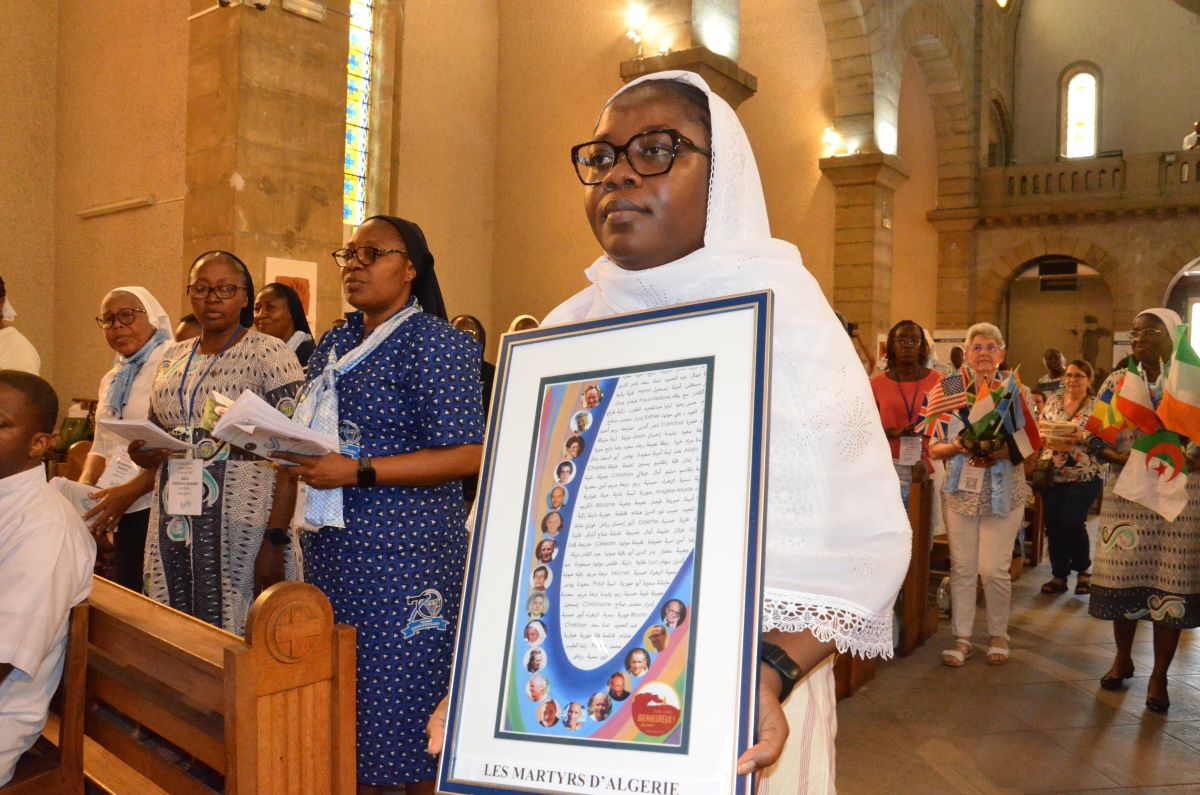
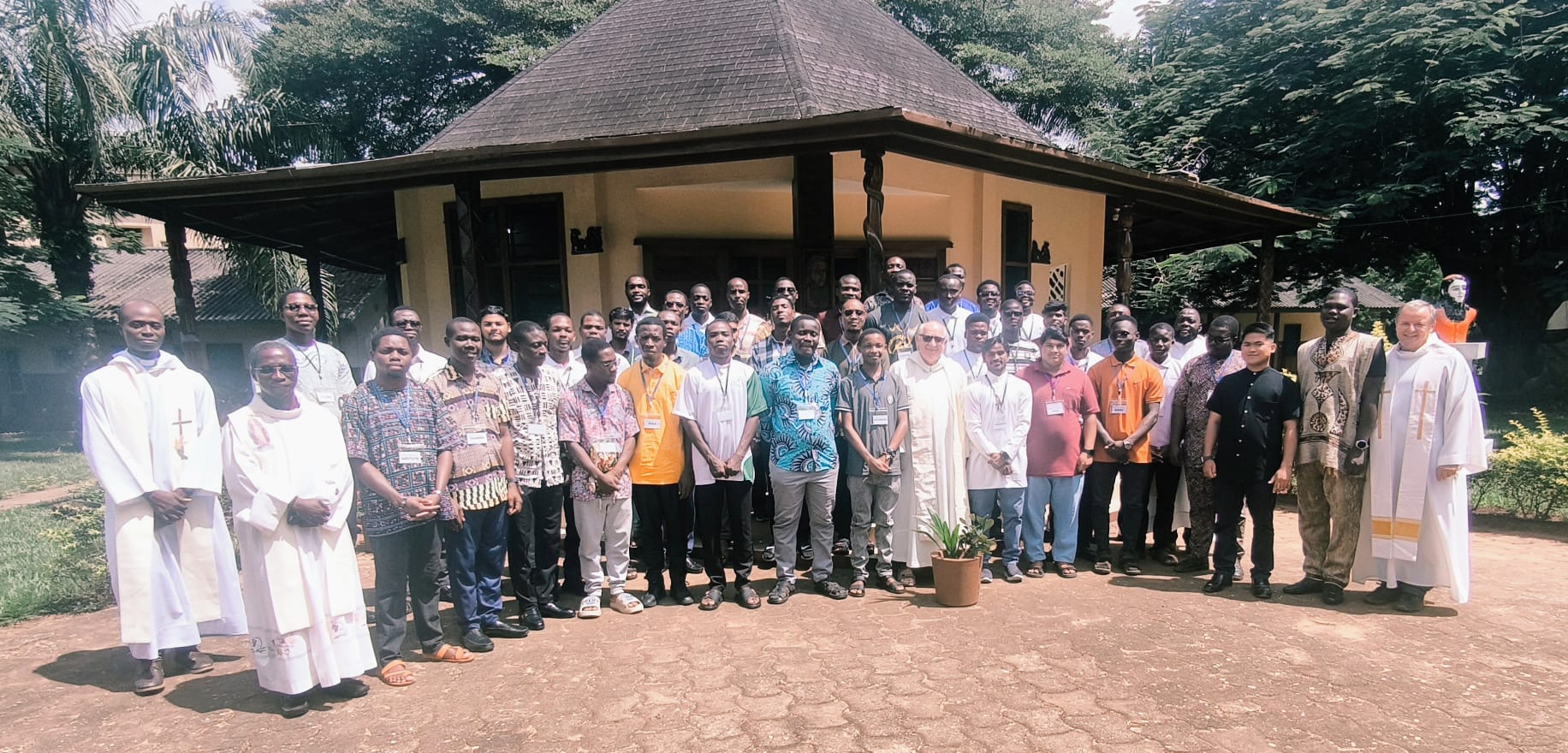
This Sunday, July 26, the pilgrims of the SMA and the Sisters of Our Lady of the Apostles (OLA) left the North of France, the birthplace of Father Planque, to reach Lyon. Their first stop in Lyon took them to Vénissieux, to the church of the Immaculate Conception, for a Eucharistic celebration presided over by Father Antonio Porcellato, former Superior General of the SMA. This is no ordinary stop: the OLA sisters’ novitiate once stood right next to this parish, and the church today houses a chapel dedicated to the Martyrs of Algeria.
A Chapel, Two Sisters, One Shared History
Among the nineteen Christian martyrs of Algeria beatified on December 8, 2018, in Oran, are two religious sisters of the Congregation of the Sisters of Our Lady of the Apostles: Blessed Angèle-Marie Littlejohn and Blessed Bibiane Leclercq. Alongside the Dominican bishop Pierre Claverie, six other religious sisters, four White Fathers, seven Trappist monks of Tibhirine, and one Marist brother, they make up this community of witnesses killed during Algeria’s “black decade.”
Angèle-Marie and Bibiane were killed together on September 3, 1994, while preparing for Mass. What stands out in Father Porcellato’s account is the conscious choice they made before their deaths. They had been offered a chance to leave, to get out of Algeria to safety. Bibiane had answered that she chose “to stay and be a place of hope in this land of Algeria.” Angèle-Marie, for her part, said she was not “afraid,” and that “one must simply live the present moment well.” These were, in the preacher’s words, lives “given” — just as much as that of Father Christian de Chergé, the Trappist monk of Tibhirine, whose spiritual testament opens with these words: “If it should happen one day — and it could be today — that I become a victim of the terrorism which now seems ready to encompass all the foreigners living in Algeria, I would like my community, my Church, my family, to remember that my life was given to God and to this country.”
Testimonies from Those Who Knew Algeria
Sister Marie-Claude Sohier, with more than sixty years of religious life, part of it spent in Algeria, shared: “Seeing our sisters, who have their chapel in this church, moves me deeply, because of course I find myself back in Algeria with them.” Her testimony recalls an aspect often left unspoken: the black decade did not only claim the lives of religious men and women, but also a great many civilians, especially intellectuals and teachers, as well as around a hundred imams killed for refusing to sign a fatwa calling for the killing of non-Muslims — a memory that, she says, was honored even at the 2018 Oran beatification ceremony, where “there were more Muslims at the ceremony than Christians.” What she remembers most from her years in Algeria is a population she describes as “very, very, very welcoming,” adding: “you feel like you’re among family there.”
Sister Éloïse Murielle Ahou, from Côte d’Ivoire and currently on mission in Algeria, voiced a similar emotion upon discovering the chapel during the pilgrimage: “Words could not translate my feelings,” she said, adding that as a missionary in Algeria today, “Angèle Marie and Bibiane are, for me, symbols of resilience, of a mission that gives everything, even one’s own life.” She pledged to share, once back in Algeria, the existence of this Lyon memorial with the local Christian community, “so that, at the very least, when they pass through France, they can know that a small part of Algeria is here, in Lyon, in Vénissieux.”
A Memory Turned Toward Today
In his homily, Father Porcellato did not want to confine this memory to the past alone. He linked the sacrifice of Algeria’s martyrs to that of many other missionaries who died young on the West African coast, and to the parable of the field containing a hidden treasure, which he wove throughout his address: for the Brésillac missionary family, that field was long Africa itself — a land where the seed of the Gospel bore much fruit, and which, having received so much, is now in a position to give in return.
The question he put to the assembly sums up the spirit of this stage of the pilgrimage: is this gift of life, embodied to the very end by Angèle-Marie and Bibiane, renewed each day in the choices each of us makes? Vénissieux, with its chapel of the martyrs, is thus not only a place of remembrance, but a call to decide in the present — after the example of these two sisters who, though given the chance to flee, freely chose to remain in the service of a land they had chosen to love to the end.
A Place That Still Speaks
The parish priest, Father Xavier Bizard, of the Emmanuel Community, likewise highlighted the significance of this dual historical presence in his church: that of Father Chevrier and the priests of the Prado, who first brought the faith to this working-class neighborhood a hundred and thirty years ago, and that of the OLA sisters, whose neighboring convent long nourished the parish’s life. “In this church, there are, in a way, two roots,” he explained, seeing in it the sign of a missionary vocation still very much alive, in a cosmopolitan neighborhood where residents from many African countries cross paths today. His message to both missionary families was simple: “Be faithful to your charism, to your missionary vocation. Keep bearing fruit wherever you are,” he said, noting that a hundred years after the first sisters arrived, the Christian community of Vénissieux, far from fading away, “tends to grow.”
Coming from Nigeria, Mrs. Ibru Margaret, a lay associate of the SMA province, offered a testimony filled with the same gratitude: “It’s been really very, very wonderful being able to relive the history of Planque and Brésillac. It’s something that teaches you that in this life you may be the planter, you may not be the one to water it.” She shared that she carries this thought into her prayer as well: “I’m saying to God, please, people who have been helping me to plant, to water what I’ve planted, give them to me. And those that have to water what they’ve planted, allow me to see them so I can even carry them further.” And she concluded with what she takes home from this experience: “It’s very important that we know that we are created for purposes, and we must not miss this purpose in life.”
Father Nkhoma Mijoni, a Zambian missionary serving in Tanzania, summed up the spirit of the day in these words: “If our first missionaries gave their life to God, to the people of God, to the people of Africa, what can I give myself, what can I do for the African people?” This may well be the deepest meaning of this Lyon leg of the pilgrimage: the chapel of Algeria’s martyrs in Vénissieux does not lock Angèle-Marie and Bibiane away in a closed chapter of the past. Instead, it places them within an ever-open chain of lives given, one that every generation of missionaries is invited to carry forward.

Leave a Reply