
'/%3E%3C/svg%3E)

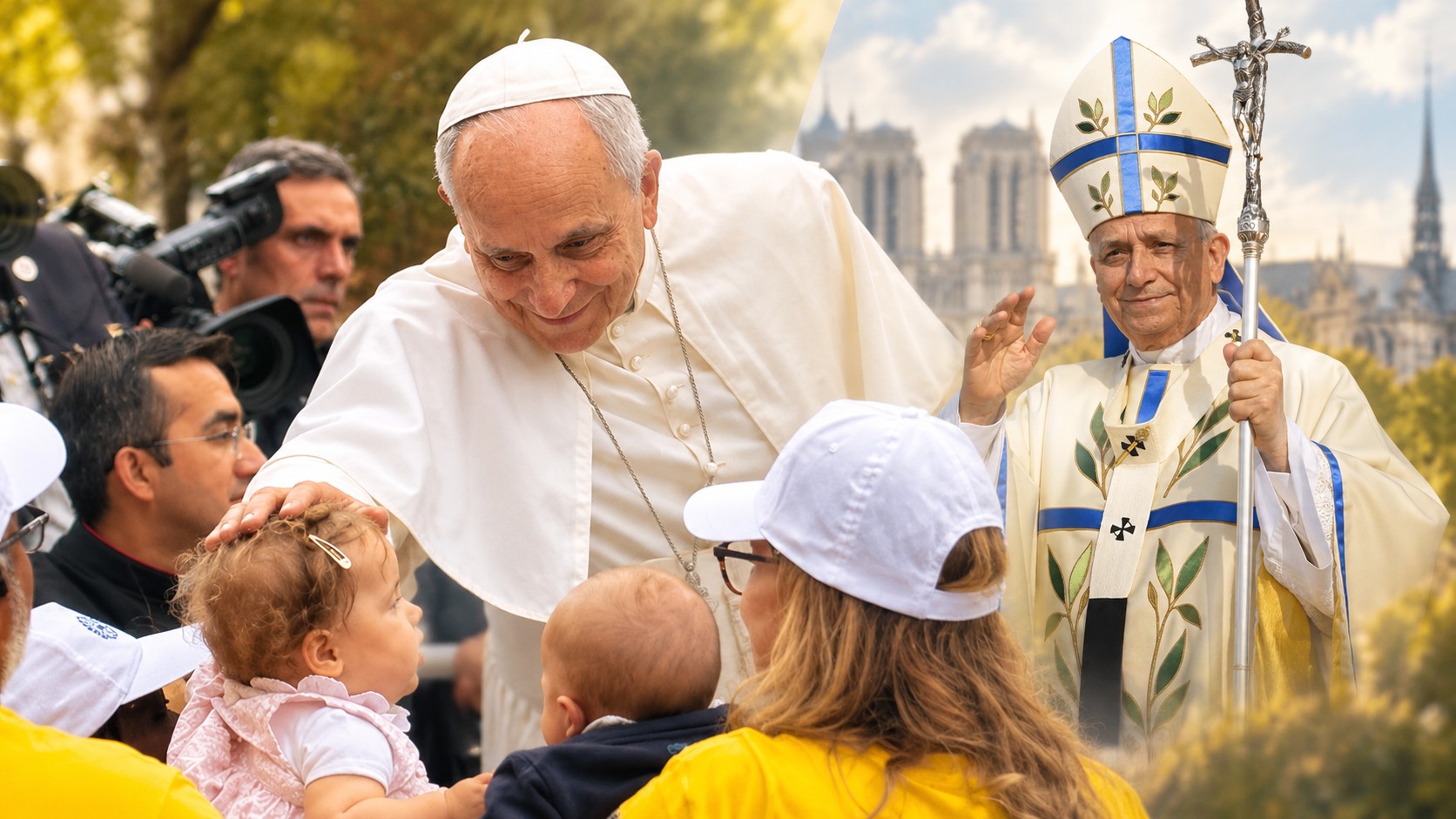
The Pope’s 25–28 September apostolic journey to France brought Catholicism into the national conversation on faith, laïcité, human dignity, peace and the future of Europe. Its crowds and media reach were striking, but the more enduring question is what the Church in France will do with the momentum created by the visit.
From Paris to Lourdes and Metz, Pope Leo XIV’s first apostolic visit to France unfolded on a scale that few expected. An estimated 800,000 people attended the open-air Mass in Paris, some 80,000 young people gathered at the Stade de France, and more than 1.3 million people attended the principal public events across the journey. France Télévisions reported that more than 23 million people followed the visit on its television channels and platforms, while videos connected with the coverage generated more than 80 million views on social media. Yet the significance of the visit cannot be measured by numbers alone. Leo XIV used the four days to engage questions at the heart of contemporary France: What does it mean to be human? What place can faith occupy in a secular society? How should freedom be understood? Can Christian roots still contribute to the common good? And can a Church that has experienced profound internal wounds still speak credibly about hope, dignity and reconciliation? His message was both pastoral and challenging.
A France that is secular, but still marked by Christianity
At the Élysée Palace, Leo XIV did not present France as a country that should abandon its secular identity. Instead, he acknowledged both its diversity and its Christian inheritance. He described France as a nation with “rich Christian roots” and linked the republican ideals of liberty, equality and fraternity to ethical questions that can also find inspiration in the Gospel. He went further by proposing his understanding of a “just laïcité”. In his view, secularism should not mean excluding religion from public life or education. Rather, the State and religious communities can cooperate, while remaining distinct, in the service of the common good.
This was one of the most consequential aspects of the visit because it touches a question that has long shaped the French relationship with religion. Leo XIV did not challenge the secular character of the Republic; he challenged the idea that secularism requires religious convictions to become invisible.
The response of French society suggests that this distinction resonates with at least part of the population. A Verian survey conducted before the journey found that 48% of respondents regarded Leo XIV as a moral reference, while 42% saw him as a spokesman for forgotten or vulnerable people. The same survey found that 53% expected him to speak about peace in the world, while 32% wanted him to address poverty and exclusion. That does not amount to a return to Catholic France. It does, however, indicate that the Pope’s moral voice was being heard beyond regular churchgoers.
The search for meaning
Across the different stages of his journey, Leo XIV returned repeatedly to the question of human thirst. At the Mass in Paris, he spoke of the thirst for happiness, love, truth, communion and fulfilment, warning against the temptation to fill the inner void through consumption, entertainment and material satisfaction. He invited people to return to Christ as the source of “living water.” The choice of language was significant. Rather than beginning with institutional questions, the Pope began with the human person.
That approach may help explain why his message reached people who do not necessarily practise the Catholic faith. A survey by Verian found that the Pope was associated above all with human qualities such as benevolence, closeness and attentiveness, and that 30% considered him the personality or institution most legitimate to carry a message of hope, peace and unity. The visit therefore revealed an interesting paradox. France remains deeply secularized, but secularization has not necessarily eliminated questions about transcendence, purpose or moral meaning.
The crowds: revival or something new?
The extraordinary crowds inevitably revived discussion about a possible Catholic resurgence. There are reasons for such optimism. France has experienced a striking rise in adult baptisms: 13,234 adults were baptized in 2026, an increase of 28% over 2025, and the number has more than tripled in ten years. More than 8,000 adolescents were also preparing for baptism. Young adults aged 18–25 have become the largest age group among adult catechumens. The Pope himself highlighted this phenomenon as a “sign of rebirth” and a “beautiful surprise of God” when he reflected on his journey after returning to Rome.
But the evidence does not justify saying that France has simply become Catholic again. The rise in adult baptisms exists alongside long-term decline in Mass attendance and religious affiliation. Analysts have described the current trend less as a restoration of the old Catholic order than as a movement from a “Catholicism of transmission” toward a “Catholicism of adherence”—a faith increasingly chosen rather than simply inherited. The young people at the Stade de France therefore matter not because they prove that the past has returned, but because they point towards a different possible future.
A demanding message to the Church of France
Perhaps the strongest part of the Pope’s visit was directed not at the French political authorities but at the French Church itself. At Notre-Dame, Leo XIV urged the Church not to become a refuge from contemporary society. He called it to be an open, missionary and hospitable Church, attentive to those who are distant and confident in the missionary contribution of lay Catholics.
At the Institut Catholique de Paris, he focused on the growing number of catechumens and warned about the “post-baptismal void”. New Christians, he said in substance, need more than the sacrament itself: they need community, formation, prayer, Scripture, doctrine and liturgical life. That may prove to be one of the most important lessons of the journey.
The challenge for the French Church is not simply to celebrate the growing number of people asking for baptism. It is to create communities capable of receiving them, forming them and accompanying them over many years.
This is where the imagery of Notre-Dame becomes particularly powerful. A cathedral can be rebuilt in a few years; rebuilding Christian communities is slower. It requires patient pastoral work, formation, personal accompaniment and credible Christian witness.
When Leo XIV reflected on the trip at the Vatican on 30 September, he chose one word to interpret the entire journey: “rebirth” or “renaissance”. Notre-Dame, the young people, the catechumens, the service of vulnerable people and the European vocation to peace all formed part of this picture.
Life, assisted dying and the limits of agreement
The visit was not simply a search for consensus. At Lourdes, Leo XIV spoke forcefully against France’s newly enacted assisted-dying legislation. The law establishing a right to assisted dying was promulgated on 18 August 2026.
The Pope insisted that legality and morality are not identical, rejected what he called “false compassion”, and called instead for stronger palliative care and accompaniment of people at the end of life.
His intervention inevitably generated criticism in a secular country where Parliament had already legislated on the issue. For some, it represented legitimate participation by a religious voice in a democratic debate; for others, it raised questions about the appropriate limits of ecclesial intervention in matters decided by the Republic.
But the episode also illustrates the position Leo XIV had defined at the Élysée: the Church does not claim political authority, but neither should Catholics be expected to abandon their moral convictions when they enter public life.
Technology, AI and the human person
At UNESCO, meanwhile, the Pope broadened the discussion far beyond specifically religious questions. His concern was not technological progress itself, but technology detached from ethical responsibility. He warned against a “paradise of machines” in which human beings become judged by efficiency, productivity or usefulness. He called for education, science and technology to remain oriented towards the dignity of the person.
His use of the biblical contrast between Babel and Pentecost offered a memorable framework for understanding contemporary globalisation: unity imposed through power produces domination, while genuine communion preserves diversity without sacrificing fraternity. The message was particularly appropriate to a country dealing simultaneously with technological change, political polarisation, migration, cultural pluralism and debates over national identity.
Christian roots: heritage or identity?
The Pope’s repeated references to the Christian roots of France and Europe also generated discussion. At Metz, speaking in the city associated with Robert Schuman, he presented Christianity not as an exclusive badge of European identity but as one of the historical sources of ideas such as human dignity, solidarity, peace and the common good. He immediately placed that heritage alongside openness to migrants, dialogue between religions, international law and the European project. This distinction matters in a contemporary political environment in which “Christian roots” can be invoked in very different ways. The Pope’s presentation was explicitly connected to dialogue and fraternity rather than to exclusion. His interreligious meeting at Metz reinforced that point: religious identity, he argued, should become a basis for encounter rather than conflict.
The unresolved wound of sexual abuse
No assessment of the visit would be complete without Lourdes. Leo XIV met privately with seven survivors of sexual abuse within the Church. According to Le Monde, the meeting lasted nearly two hours, considerably longer than planned, and several survivors said they felt listened to and believed that the Pope understood the institutional dimension of the problem.
At the same time, criticism remained. Some survivor organisations had wanted a broader process involving the structures representing victims and greater emphasis on institutional reform. The controversy was sharpened by remarks from Bishop Pierre-Antoine Bozo that the Church had moved beyond the “systemic dimension” of the problem—an assessment challenged by survivor advocates.
The Pope himself urged the bishops to continue the work of listening, truth, justice, forgiveness, reparation and prevention. This is perhaps where the credibility of the Church will be tested most severely. Words of compassion matter, but survivors are looking for structures, accountability, reparation and lasting safeguards. The question after Lourdes is therefore not whether the Pope listened. The question is what the Church does next.
A careful relationship with the Republic
The visit also provided an illuminating picture of the French state’s relationship with the Catholic Church. Emmanuel Macron received Leo XIV at the Élysée and participated in the discussions on bilateral relations and global issues including peace, artificial intelligence and climate. At the Paris Mass, Macron himself was absent while Prime Minister Sébastien Lecornu and Brigitte Macron represented the French authorities. He subsequently changed his schedule and attended the final Mass in Metz. The sequence demonstrated both sides of the French model: institutional cooperation and clear differentiation between political authority and religious worship. Rather than resolving the debate over laïcité, the visit exposed its continuing complexity. France can remain a secular Republic while religious communities participate visibly in public discussion. The unresolved question is where precisely the boundaries of that participation should lie.
What remains after the Pope has left?
The most important outcome of the visit may therefore not be a particular speech, a crowd figure or a television audience. It may be the questions that remain. Can a secular France acknowledge its Christian inheritance without turning it into a political identity? Can Catholics contribute to public debate without seeking political privilege? Can the Church defend human dignity firmly while remaining in dialogue with those who reject its conclusions? Can the enthusiasm of young people become sustained discipleship? Can the rise in baptisms become living parish communities? And, above all, can the Church restore credibility through a culture of truth, prevention, justice and reparation? Cardinal Jean-Marc Aveline has described the visit as a moment in which many seeds were planted and said that the Church of France now has the responsibility to “water the seeds.”
That image captures the situation well. Pope Leo XIV has not restored the France of the past, nor did he attempt to. Instead, he encountered a France that is secular but still deeply marked by Christian history; politically divided but searching for unity; technologically advanced but concerned about the meaning of progress; and religiously diminished in institutional terms while witnessing unexpected signs of renewed interest among young people and adults.
The visit has therefore left France with neither a return to Christendom nor the disappearance of Christianity from public life. It has revealed something more complex: a country in which Catholicism remains at once faith, memory, culture, social service and, for a growing number of people, once again a personal choice. For the Church of France, the task now begins after the applause has ended. The crowds have demonstrated visibility. The catechumens have demonstrated possibility. The debates have demonstrated that the Church still has something to say. The survivors have demonstrated that credibility must be earned. As Leo XIV himself prayed after his return to Rome, the journey should bear “abundant and lasting fruits.” The real measure of the visit, therefore, will not be how many people came to see the Pope, but whether what they heard continues to shape the Church and French society long after he has gone.
Leave a Reply