
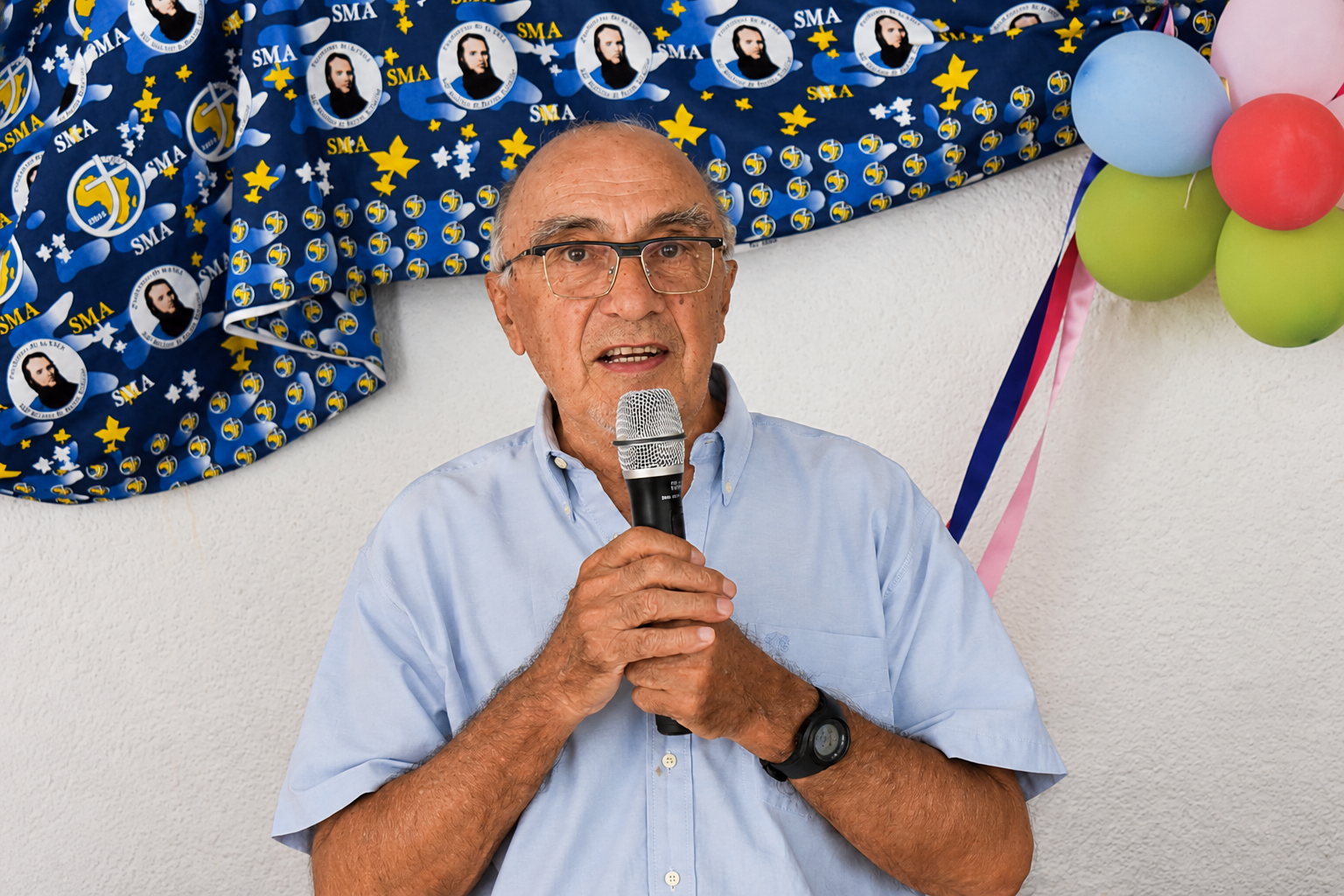
At 77, Father Alain Derbier, a missionary of the Society of African Missions (SMA), is preparing to return one last time to Ivory Coast – not to resume his post, but to say goodbye. He is now the last French white missionary still serving in that country. On the occasion of his golden jubilee of priesthood, he gave an intimate interview, while the SMA Superior General, Father François du Penhoat, addressed a deeply moving letter to him.
“I am aware that I am reaching the end of the journey”
It is with serene lucidity that Father Alain Derbier opens his testimony: “I am aware that I was reaching the end of the journey.” At 77, his health is declining, even if it is not always visible. After fifty years spent serving the Church in Africa, he is preparing his final departure for Ivory Coast. But this time, it is not for a new mission – it is to say farewell. “I’m not going to leave like a thief,” he says, using an expression dear to him. “I will take the time to greet my friends, this country I have loved. Since I have the chance to somehow organise my departure, I think I must do it.” He even envisions a new form of presence: “Perhaps another way of being a missionary, in silence, in discretion.”
1970–2026: The end of an era
Arriving in Ivory Coast in 1970, at the age of 21, as a seminarian cooperator at the minor seminary of Gagnoa, Alain Derbier witnessed decades of upheaval. At that time, the SMA had nearly 150 French priests in the country. Today, he is the last one. Asked about this reality, he responds without bitterness: “It is in the order of things. The elders must leave, the children must grow.” He points out that the Ivorian clergy, which numbered only about forty priests in 1970, today counts more than a thousand. And he highlights the irony of history: “Now it is African missionaries who come to evangelise old France. It is beautiful; we must live it without bitterness.”
A missionary unlike others
From the very start, Alain Derbier distinguished himself by his approach to inculturation. Ordained a priest in 1976, he asked his bishop for a year of village immersion, living for nine months among the people, sharing their food, their water, their living conditions. “I did not come to teach; I came to share,” he insists. “The Gospel we proclaim must open itself, so that Africans can live it with the genius of their own culture.”
This cultural sensitivity was also deployed between 1987 and 1991, when he took charge of the African Museum in Lyon. He profoundly renewed it, transforming it from a colonial showcase into a place of encounter and dialogue. In his jubilee letter, the Superior General, Father François du Penhoat, praises this legacy: “For you, objects are not looked at for themselves, for the simple pleasure of the eyes. They are above all witnesses charged with meaning. […] These objects invite us to look further and think further, towards the people who produce and use them.”
“How you love them!”
Among the most striking memories of his missionary life, Derbier recalls a guided tour at the museum. At the end of the visit, a man approached him and simply said: “Goodbye, how you love them.” The priest confides: “That is the most beautiful compliment I have ever received on my missionary life.” He does not hide the tensions either. He recounts writing to President Félix Houphouët-Boigny to denounce persecutions against Christians, while simultaneously working on the construction of a large church and a mosque, in a spirit of interreligious fraternity. He even received a medal and a presidential envelope – proof that his commitment to peace had not gone unnoticed.
A look without bitterness at the end of an adventure
Asked what it means to be the penultimate SMA missionary in Africa (one colleague remains in Benin), he answers with humility: “There is no bitterness to be had. The years have passed. We did the best we could, with our qualities and our faults.” He warns young African priests against certain pitfalls: “I am a little shocked to see some young confreres who are very demanding about comfort, nice cars, air conditioning. I never had air conditioning, nor a servant.” He urges them not to renounce their culture, to remain simple, and to detach themselves from ambition.
“Africa changed me”
The Superior General’s letter quotes a confession from Father Derbier: “Africa changed me. I feel closer to God.” That is perhaps the heart of it: half a century spent giving, but also receiving. “Not only did they give me a great deal, but I also asked a lot of them,” he admits. “I never behaved like someone who came with his wisdom.”
As he prepares to board the plane for Ivory Coast, for what will likely be his last journey, he insists that the bonds will not be broken: “One way or another, I will always be there – spiritually, psychologically. And with today’s media, we can easily stay in touch.”
The mission continues
As he prepares to return, he is not simply leaving a place. He is leaving behind a part of his own story. And perhaps this is the paradox at the heart of every genuine mission: we arrive as strangers, we learn to love, we serve with humility, and one day, when it is time to leave, we discover that the land to which we were sent has become a home. His own words capture this mystery beautifully: “When we give our lives, we give them to God, but we also give them, and perhaps above all, to the people to whom we are sent.”
Father du Penhoat concludes his letter with a quote from Saint Augustine, echoed by Pope Leo: “Do justice, because justice and peace embrace each other and are not in disagreement.” These words seem tailor-made for the life of Alain Derbier, who never ceased to seek peace through justice, dialogue, and encounter. He is leaving, but he leaves behind an Ivorian Church that is standing, prosperous, and now missionary in its turn. “It is not a failure,” he repeats. “Thus goes life.”
Leave a Reply