
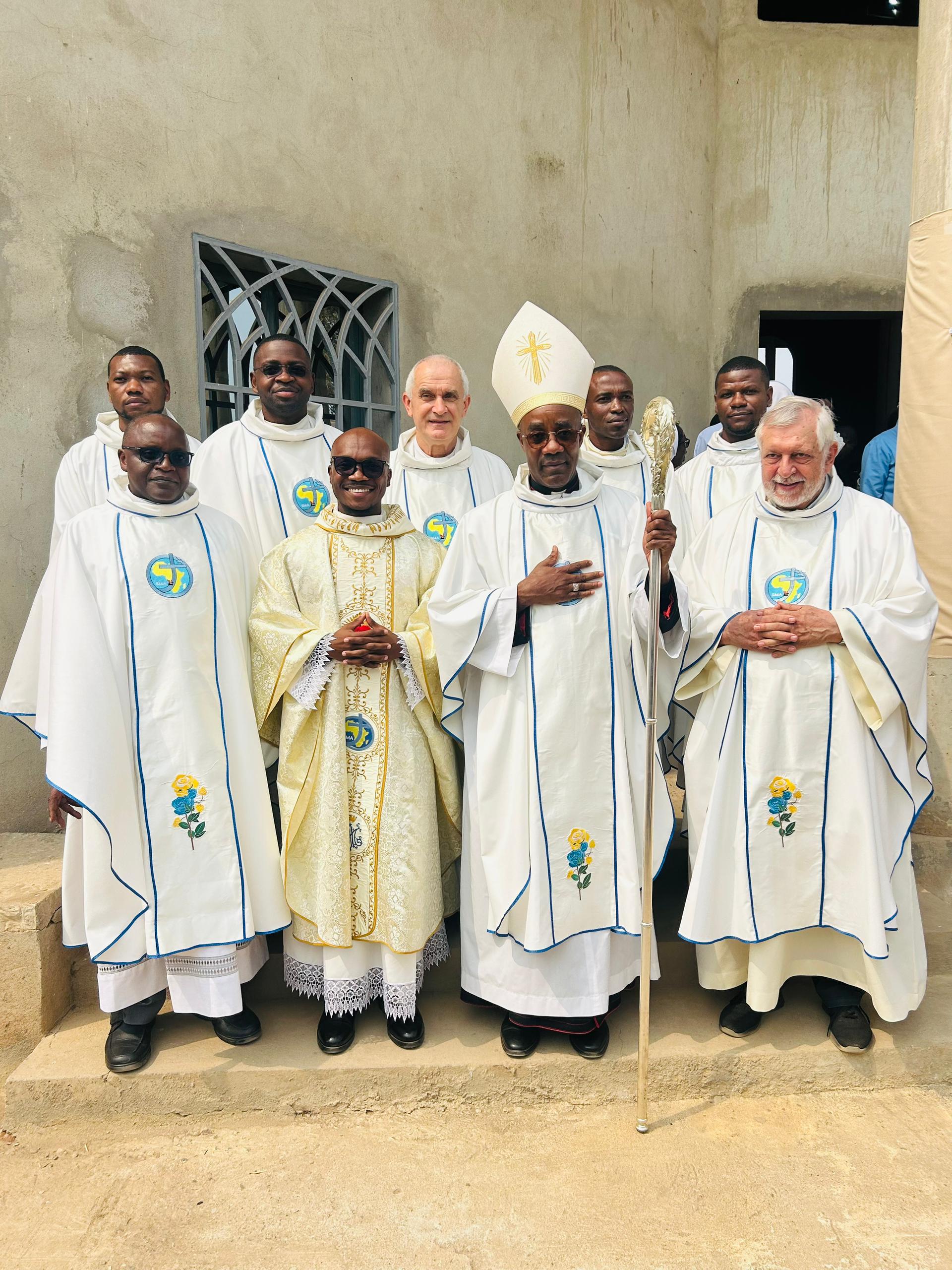
Today, at Bom Pastor Parish in Kicolo, Sebastião Moniz was ordained a priest by the imposition of hands of Bishop Maurício Agostinho Camuto, C.S.Sp.
He becomes the first Angolan priest of the Society of African Missions (SMA).
The journey that brought him to the altar did not begin in a seminary. It began much earlier and, for a time, it seemed to be heading in an entirely different direction.
Fr. Sebastião is the second of eight children: three girls and five boys, and the first boy in his family. Both his parents were teachers, and from an early age they taught their children the importance of belonging to the Church. Long before he could imagine becoming a priest, Fr. Sebastião was already playing at being one. After returning from Mass, he would gather his younger siblings, give them biscuits and imitate the priest. Using a small version of the Catechism, he would teach them the order of the Mass. Looking back now, he sees those childhood moments differently.
“I would say that this was the foundation of everything.”
Yet when he grew older, his plans for the future were not centred on priesthood.
After secondary school, fr. Sebastião began teaching at a primary school while saving money to continue his university studies. He was a young man with dreams, ambitions and a professional future he was beginning to build.
Then, as he puts it, the call to priesthood “knocked harder.”
The call was not something he immediately embraced. Although he had grown up in the Church, there came a period when Fr. Sebastião deliberately decided to put Church life aside. For some times, he did not participate in Church activities. He was focused on his future: what to study, what career to pursue, where to live and how to build his life. Then, one evening, while returning from school, he encountered a former friend from his altar server group. After talking for some time, his friend left him with a sentence that would change the course of his life:
“Sebastian, you left me alone. I need you in the group. The group is waiting for you!”
The words were simple. For Fr. Sebastião, they became something much more. He describes the encounter as his own “Damascus experience.” He came to believe that, through his friend’s words, he was been reminded that he had not simply left a group;that he had also distanced himself from God and from the community of the Church.
And so he returned to church.
He became involved in Church activities, took leadership roles, participated in formation programmes and gradually rediscovered the life of the Church. Later, he began discerning the priesthood more seriously. Looking back, he sees that encounter as a decisive moment in a vocation that had been quietly present since childhood. His return to Church life also awakened a deeper desire to serve. In his outstation and parish, Fr. Sebastião noticed that many people lacked sufficient knowledge about the faith and about what it meant to belong to the Church.He wanted to help.
While attending his own Confirmation classes, he began helping a catechist teach children preparing for Baptism and First Holy Communion.Sometimes, on Saturdays, he would teach the children just two hours before attending his own Confirmation class.
Something slowly began to change.His concern moved beyond his own community. He started thinking about people in other parts of his province, then beyond his province, and eventually beyond Angola.
“I began to feel a desire to go out and share what I had heard and what I had come to know of Jesus.”
It was there that Fr. Sebastião began discovering the missionary dimension of his vocation. He did not simply want to serve within the boundaries of the community he knew. He felt drawn toward a Church that goes out, crosses boundaries and brings the Gospel to people wherever they are.
When asked why he chose the Society of African Missions, Fr. Sebastião has a characteristically light-hearted answer:
“I choose the SMA because I love travelling.”
There is humour in the answer, but also truth.
He wanted to go beyond what was familiar, not simply geographically, but culturally and humanly.
In the SMA, he discovered a missionary family and an identity that gave direction to the desire that had already been growing within him.
“I discovered a family and a missionary identity that gave direction to that desire.”
Formation would then teach him that vocation does not require a person to stop dreaming. Rather, it asks that dreams be transformed and placed at the service of something greater.
“The SMA has taught me to dream beyond myself, beyond my own country and beyond my own immediate reality.”
One of the first great challenges of his formation was simply learning how to leave home. Although Fr. Sebastião had always dreamed of discovering new places, actually leaving Angola was different.
When he arrived at the seminary for his philosophical studies, far from his parents’ home, neighbourhood and province, he watched the priest who had brought him leave.
“At that moment, I felt as if something in me had died.”
He had suddenly understood the cost of leaving behind the world he knew.
Yet what initially felt like loss became preparation.
The seminary brought together young men from different dioceses and backgrounds, teaching him how to live with people who were different from him. It was an early lesson in the interculturality that would later become an essential part of missionary life.
Later, another difficult period would teach him a different lesson.
Near the end of his initial formation, he was challenged to look more deeply at himself, confront aspects of his personality and allow himself to change. He also experienced the unusual path of continuing the journey for two years as a deacon before priesthood.
“This experience taught me how to allow myself to be transformed.”
Those experiences, he now believes, were necessary.
Fr. Sebastião is clear that his vocation was never a journey he walked alone.
His parents were among its first companions. His mother continued to pray for him during the years when he had distanced himself from the Church. His father initially struggled with his decision to enter the seminary and simply told him, “No.” Eventually, after speaking with the priest responsible at the time, his father told him that he was old enough to make his own decision and that, if this was what he wanted, he was free to go.
Today, his father is one of the people whose advice Fr. Sebastião values most when life becomes difficult.
Then there is Simão Abel, the former altar-server colleague whose simple invitation: “The group is waiting for you”, helped bring him back.
Simão later began his own journey with the SMA, although his path eventually took a different direction. Yet he remained a constant friend and reminder of the choice Fr. Sebastião had made.
Fr. Sebastião also remembers with gratitude the SMA priests who served in his parish: Fr. Renzo, Fr. Luigino, who baptized him, Fr. Angelo, Fr. Ceferino, who gave him his First Holy Communion, and Fr. Jacques -Alain, who was his parish priest when he began his vocation journey. Their lives gave him a concrete picture of missionary priesthood.
Among them, Fr Ceferino Miguel Cainelli, SMA, occupies a particularly important place. He was the priest who welcomed Fr. Sebastião to the SMA in 2015.
But he did more than open the door. He believed in him.
“For me, he has been a father, a spiritual guide, a brother and a good friend.”
For Fr. Sebastião, sometimes a vocation needs someone who can see something in you before you are fully able to see it yourself.
“Fr Ceferino was one of those people for me.”
Two moments stand out in particular from his formation: his Temporary Oath in June 2020 and his Permanent Oath.
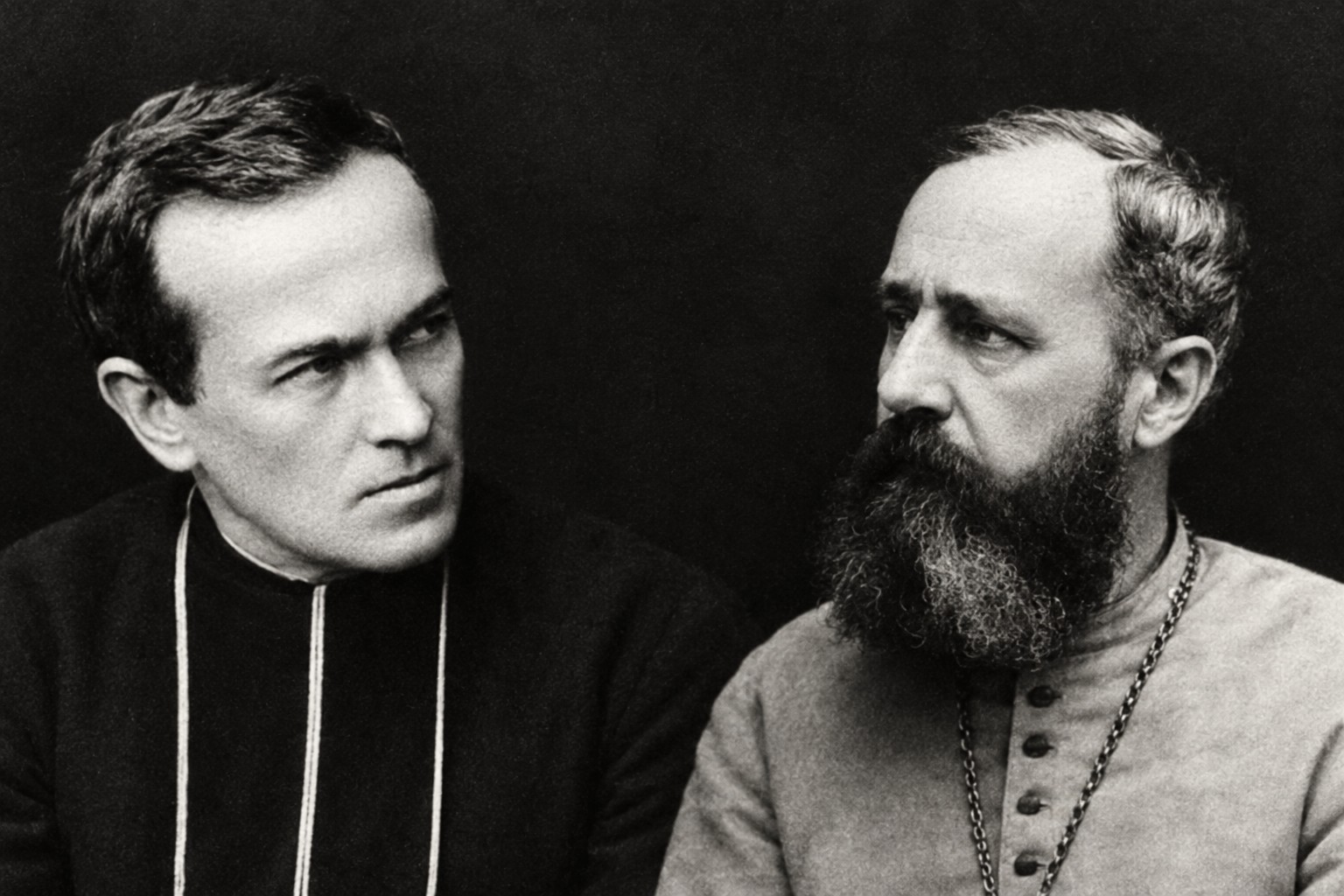
The first took place during the uncertainty of the COVID-19 pandemic. As the only Angolan completing the Spiritual Year in his group, Fr. Sebastião made his commitment in a very small gathering. Yet, in the midst of uncertainty, he experienced an extraordinary joy. That preparation also allowed him to enter more deeply into the spirit and writings of the Founder, Bishop Melchior de Marion Brésillac, and to discover what it meant to belong to a missionary family whose members could come from different cultures, languages and backgrounds.
His Permanent Oath carried an even deeper significance. It answered a question that had remained with him:
“Can something good come from Angola for the SMA?”
His answer was expressed through his permanent commitment to the SMA.
An Angolan who had grown up in a Church that received missionaries was now permanently becoming part of a missionary family himself. It was, for him, both an act of gratitude and an answer.
Today, as a newly ordained missionary priest, Fr. Sebastião does not see himself as leaving Angola behind. He carries something of Angola with him.
He speaks of the rhythm, movement, dance and laughter of his people, as well as their generosity, resilience, unity and strong sense of community.
“I am bringing a certain rhythm, movement and dance, and also laughter.”
But perhaps what he carries most deeply is the sense of family he learned at home.
“For us, faith is not simply something lived individually, it is something celebrated and experienced together.”
At the same time, he understands that being a missionary also means being willing to receive. He does not want to approach people simply as someone who has something to teach them.
He wants to listen: “I want to learn how to listen before speaking, how to receive before giving.” For Fr. Sebastião, mission is an encounter in which both the missionary and the people are transformed.
Today, the journey that began with a child imitating a priest after Mass has reached a new stage. The young man who once stepped away from the Church, who wondered what his future would look like, who returned because a friend told him that “the group is waiting for you,” has now been ordained a priest.
But Fr. Sebastião does not see priesthood as the conclusion of his formation.
It is a new beginning.
He wants to serve the poor and abandoned, to walk with people in their joys and struggles, and to be present not only when people come to the Church to celebrate, but also when life becomes difficult.
“I want to be a priest who is present to people.”
He has identified five responsibilities he wants to take seriously: remaining faithful to Christ, being available to people, becoming an instrument of forgiveness and reconciliation, remaining faithful to his missionary vocation, and remaining faithful to the SMA and its missionary identity.
Yet all of them begin with one fundamental conviction:
“Before being a priest, I am a disciple.”
That is perhaps the simplest way to understand the priest Fr. Sebastião hopes to be.
A disciple who remains close to Christ.
A missionary willing to go where he is sent.
A priest willing to listen before speaking and receive before giving.
And, perhaps most importantly, a man whose vocation may help another young Angolan believe that his own calling is possible.
Because sometimes a vocation begins with something as simple as a friend saying:
“The group is waiting for you.”
And sometimes, years later, that simple invitation leads all the way to the altar.
Brice Ulrich AFFERI

Leave a Reply