

By Pierre-Paul Dossekpli
The last SMA Plenary Council, Lagos 2026, made profuse use of the concept of listening. Listening is understood as an integral part of communication, alongside “speaking”. Speaking and listening make communication. Sociologists portray communication as “the organizing element of human life”. In this sense, when listening is absent, there is no communication, and therefore human society deteriorates.
As Prof. Jim Macnamara said, “The first communication we encounter is interpersonal communication.” In this context, listening is largely discussed at the person-to-person level. This article attempts to bring the discussion to an institutional level. It is clear that “information flows and attempts at communication occur today between governments and citizens, between corporations and their customers” (Macnamara, 2024). The same dynamic applies to a religious institution like the SMA and to its members, the people it serves, and donors.
So, what does it mean to listen as an institution? Why institutional listening? My conviction is that, if members of an institution will grow in listening, the institution itself must become a listening organization.
1. What is Organizational Listening?
This article is prompted by a recent discussion with some well-intentioned people who seem to disagree with the synodal emphasis on listening. In fact, listening is not an option when it comes to the way institutions work. Listening is not an option; it is an essential part of an organization’s life. One can say that listening is part of an institution’s DNA.
It is crucial to acknowledge that “listening is more than tokenistic attention and responses”. Macnamara defines organizational listening as the deliberate systems an institution builds so that its leaders can genuinely hear the people who speak to it — not just receive their input, but take it seriously enough to review their own policies and decisions in light of it, and respond in a way that shows they were heard. Done well, this doesn’t just resolve individual complaints; it feeds back into how the organization learns and how it relates to everyone with a stake in it (Macnamara, 2024). This is what Macnamara means by stakeholders — not to be confused with stockholders. A stakeholder is anyone who affects or is affected by the institution’s decisions, whether or not they hold any formal position or authority within it.
Listening as an institution is to put in place a permanent process that runs through the collection of data in the form of views, ideas, opinions, expertise, tendencies, context… to the decision-making.
Organizational listening presupposes that everyone has the right to speak. Acknowledging the voice of the other is to recognize his unalienable dignity. It signifies to people that they are also part of the journey, not as spectators but as participants. In fact, institutions are part of the daily conversation and affect people’s lives by their services and decisions.
Also, Organizational listening goes beyond superficial, quick assessments of what is perceived. It is an intentional, deep reflection on the data collected, in order to make sense of reality, in the light of one’s own identity. The process of organizational listening, as defined above, culminates in both organizational learning and appropriate responses to stakeholders, thus ensuring mutual benefit.
Listening as a Church is not a new element in our faith journey. We see this in the attitude of Jesus himself. In the Gospel of Matthew, Jesus asks the disciples: “Whom do men say that the Son of man is?” (Mt, 16:13). One remarkable thing is that Jesus was proactive in listening. He initiated the process, which led to Peter’s confession of faith. There are many other instances in which Jesus listened to his followers and to their context. We can say that Jesus himself introduced the idea of organizational listening.
The early Church shows the same pattern: the Hellenists’ complaint in Acts 6 leads directly to the appointing of deacons, and a comparable dynamic underlies the Council of Jerusalem in Acts 15.
So, listening, as urged by the Synod on Synodality, is not a new, alien concept being introduced in the Church. Rather, it could be seen as a revival of an essential component of ecclesial life. What then could be the benefit of organizational listening?
2. Why organizational listening?
Organizational listening supports the institution’s growth by improving its relationships with all involved. Interestingly, in the same discussion that led to this article, there is a critique of the Church’s institutional aspect. It seems that treating the Church as an institution undermines its spiritual dimension.
I have heard this disregard for the institutional dimension of the Church on other occasions. Some said, “I prefer spirituality over the Church,” or “I do not like religion; I prefer spirituality.” But which spirituality? And how does that spirituality survive in times when no institution holds and transmits it? Before proceeding to the benefits, let’s look at the necessity of the Church’s institutional dimension.
a. The necessity of institutionalization
In his article, The Pathology of Religious Institutions, Litonjua quotes Thomas O’Dea: “Religion needs institutionalization to succeed and survive.” It is clear that institutions are necessary for continuity, mission, and growth. Moreover, Lumen Gentium teaches that the Church is one reality: the visible, structured society and the spiritual “Mystical Body of Christ” are not two separate churches but one “complex reality” composed of divine and human elements. In this sense, the making of the institutional dimension of the Church is itself a divine mission.
“The Catholic Church can succeed as an institution while failing as a church. But it cannot succeed as a church while failing as an institution,” said Litonjua, quoting Peter Steinfels. Institutions can function well even as the Church’s ultimate goal is forgotten. But when the institution becomes pathological, it necessarily affects the Church’s mission. Without going into further detail, these effects of a pathological institution have been seen in the case of sexual abuse and its management by some Church institutions.
One of the greatest causes of institutional pathology is when institutions stop listening. Failure to listen causes more damage to institutions than a lack of resources. Litonjua made this remark: “The Catholic Church fails in its mission when its leadership and authority are not respected by its members, because they are not responsive to their needs and aspirations, when bishops, priests, and laity do not listen to each other and cooperate with each other in their different roles but common tasks…” Seen from the other side, this is precisely what makes organizational listening so valuable: not a soft or optional practice, but the very thing that keeps an institution healthy enough to fulfill its mission.
b. The Benefits of Organizational Listening
Organizational listening yields concrete benefits across the life of an institution. It deepens engagement: members and stakeholders who feel heard develop loyalty, commitment, and a lasting sense of belonging, which for a missionary institution like the SMA is as vital an asset as any material resource. Listening also functions as an early-warning system. Most crises do not erupt without warning; they build slowly, out of dissatisfaction, unaddressed complaints, or poor practices that stakeholders already sense but leadership has not asked about, or has asked about and ignored. Jim Macnamara puts this plainly: “effective organizational listening can save organizations major financial costs, disruptions to their operations, and reputation damage” (Macnamara, 2024).
The same logic extends to trust and reputation more broadly. An institution that listens is one that can rebuild credibility when it is damaged and sustain it when it is not, keeping the organization focused on its actual mission rather than drifting into distractions that have little to do with its stakeholders’ real concerns.
Listening matters just as much in seasons of change and in the exercise of authority. Institutions are never static, and periods of transition are also periods of tension; an organization that listens well is better able to reduce resistance, learn from those affected by change, and adapt without losing the support of its members. The SMA knows this from experience: since the early 2000s, and especially from 2006 onward, Africa alone has moved from a single Unit to multiple provinces, districts, and delegations, a transformation unfolding alongside the wider challenges of digital change.
The same holds for governance and equity. Authority that listens is authority that is freely accepted rather than merely imposed, and this is especially urgent for the young, who are increasingly disengaged from institutions they feel do not hear them, and for the marginalized, whose voices often require the institution to reach out rather than wait to be addressed. In each of these areas, listening is not a courtesy an institution extends when convenient; it is the condition for its continued legitimacy and life.
3. Going Forward…
a. Listening already practiced, if not yet named
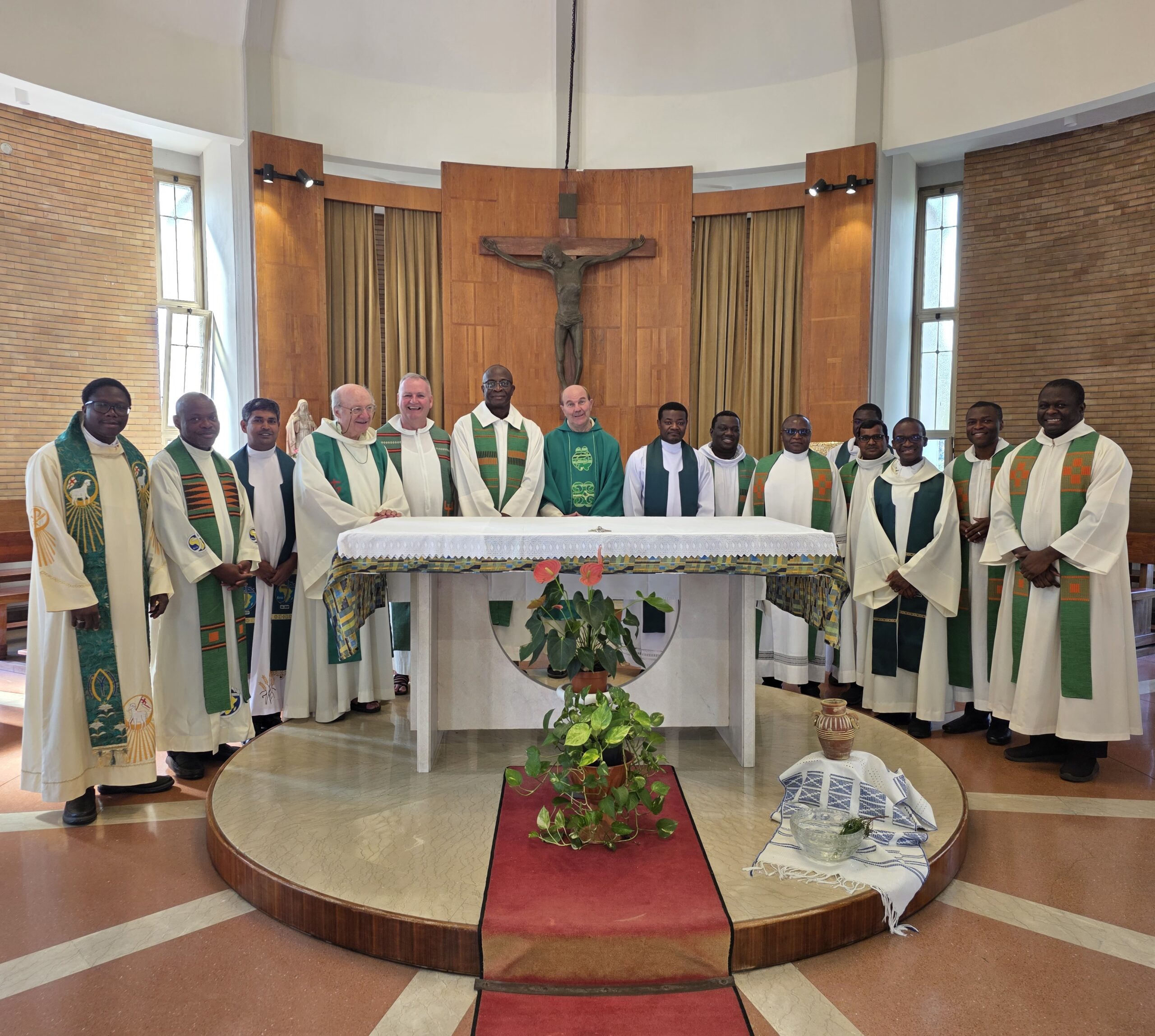
This reflection began as a follow-up to Lagos 2026, and it is fitting to end by returning there. In his opening address to the Plenary Council, the Superior General did not use the word “listening,” yet the practice ran through nearly everything he said. He named the burdens confreres carry before asking anything of them. He recalled that “you have brought suggestions and concerns, and the General Council has brought its own,” acknowledging two streams of input converging on the same table. He spoke of weaving a new rope “at the end of the old rope,” a fitting image for an institution that must keep listening across generations if it hopes to remain faithful to those who came before it. Lagos 2026 was, in this sense, organizational listening already in practice, even before it was named as such.
b. Institution and spirit, held together
This also allows us to return to the objection raised earlier: that treating the Church as an institution somehow diminishes it, that spirituality and structure pull in different directions. The Superior General’s own address suggests otherwise. His call to hold together “prophetic vision and realistic action,” to remain faithful to a long-term missionary commitment while being pragmatic in the present, is not a compromise between the spiritual and the institutional. It describes how the two work together. An institution that only prophesies without listening becomes disconnected from the people it serves; an institution that only manages without prophesying becomes an administration without a soul. Listening is what holds the two together, translating the burdens confreres carry into decisions that address them, and the prophetic vision back into structures capable of sustaining it.
c. Toward an Architecture of Listening
For the SMA, then, the task ahead is to ensure that listening does not remain an occasional posture, adopted in moments of gathering like Lagos 2026, but becomes embedded in the institution’s ordinary life, in its “organigram,” as suggested earlier. This is true for the SMA in particular, but it holds for any Church institution: dioceses, congregations, parishes, and movements alike face the same task of turning listening from an occasional gesture into a structural habit. Macnamara speaks of an “Architecture of Listening,” the deliberate design of structures, channels, and processes through which an organization actually receives and acts on what it hears, rather than leaving listening to goodwill or chance.
Developing such an architecture for the SMA is a task for another reflection, but it would likely include clear channels through which confreres, lay collaborators, and the people the SMA serves can bring forward their concerns; regular processes for reviewing what has been heard and how the institution has responded; and formation that helps future leaders see listening not as a burden added to governance but as one of its essential tools. As the Superior General reminded the Council, it is together, “in a spirit of mutual trust,” that an institution finds the strength to face what lies ahead. Organizational listening is one of the most concrete ways that trust is built, tested, and renewed.
Listening does not happen by chance; it is a process that must be organized in both its design and implementation, hence an Architecture of Listening. Just as we have structures for speaking (newsletter, apostolic letter, website, digital platforms…), we need structures for listening embedded in the institution’s organigram. It requires resources, personnel, and clear procedures.
References
Macnamara, Jim. Organizational Listening II: Expanding the Concept, Theory, and Practice. Peter Lang, 2024.
Radcliffe, Timothy. Listening Together: Meditations on Synodality. Liturgical Press, 2024.
Vatican Council II. Lumen Gentium. Vatican City: Libreria Editrice Vaticana, 1964. https://www.vatican.va/archive/histcouncils/iivaticancouncil/documents/vat-iiconst19641121lumen-gentium_en.html.
Litonjua, M. D. “THE PATHOLOGY OF RELIGIOUS INSTITUTIONS.” International Review of Modern Sociology 39, no. 2 (2013): 283–323. http://www.jstor.org/stable/43496473.




Leave a Reply