
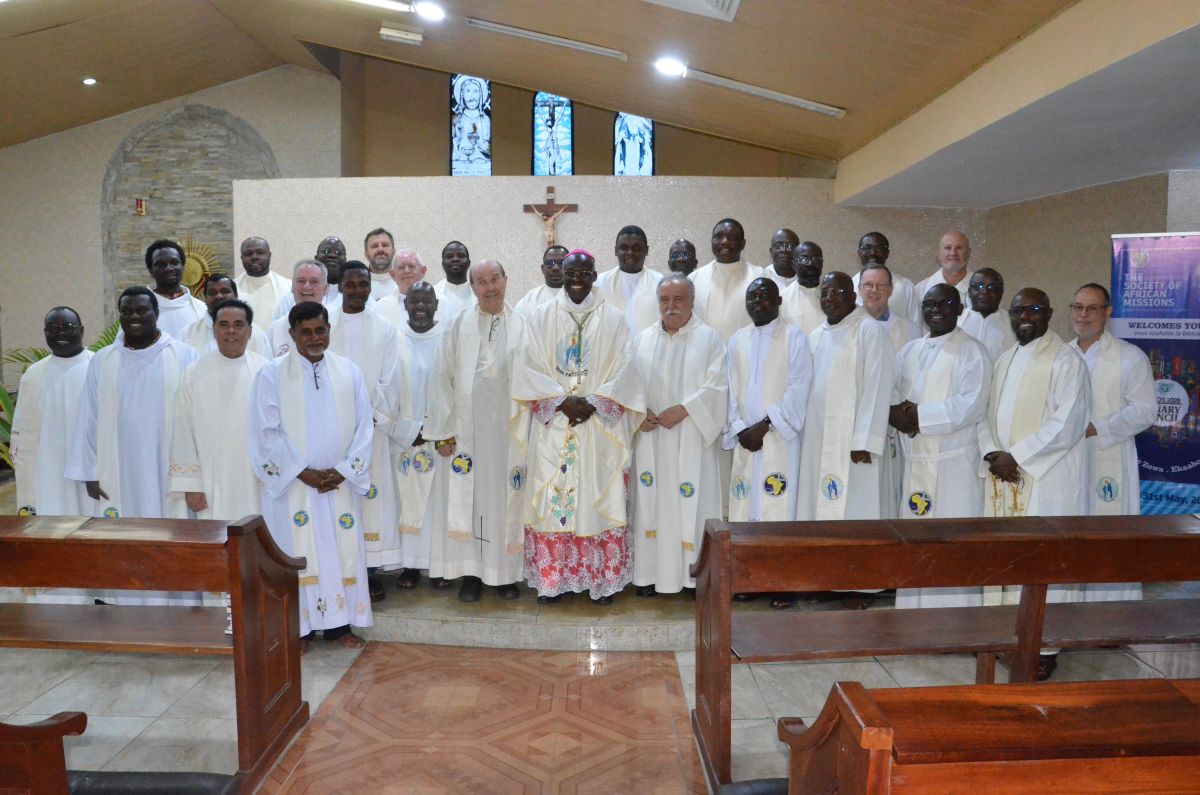
An encounter with Bishop Francois Gnonhossou, sma, Bishop of Dassa-Zoume, on the occasion of the SMA Plenary Council
By Pierre Paul Dossekpli
Plenary Council, Lagos 2026
Three hundred kilometres of road, the Benin-Nigeria border, repeated police checkpoints, potholed stretches of tarmac and the notorious Lagos traffic: Bishop Francois Gnonhossou of Dassa-Zoume endured all of this to attend just one day of the SMA Plenary Council. A journey that says everything about the man and his vision of mission.
An exhausting journey for a single day of fraternal joy
He arrived the evening before and left the following morning: such was Bishop Gnonhossou’s schedule for the SMA Plenary Council. Yet when asked whether the journey was not out of all proportion, his answer comes swiftly, calm and convinced.
When you are going somewhere and you have a purpose, you will cross every obstacle to get there. Jesus wanted to save humanity, and suffering did not stop him.
— Bishop Francois Gnonhossou
For him, the Plenary Council is no ordinary administrative gathering. It is, he says, the sanctuary of SMA decisions — a space where men from every horizon come together to listen to one another, share their joys and difficulties, and form what he calls a missionary family.
The joy of these reunions is very real. The moment he walks into the room, memories surface and embraces follow. Money cannot buy this, he confides with disarming simplicity. Only the love we have for one another allows us to reach that depth of joy.
A missed flight and a found bishopric: a vocation shaped by Providence
How does one become a bishop? By papal appointment, certainly. But Bishop Gnonhossou tells a different story — one built on an air travel mix-up, a missed flight, and a mysterious summons. A story in which, he insists, God arranged everything.
It begins during a pastoral visit to Cote d’Ivoire, when he is still a member of the SMA General Council. For the outward journey he had flown Air France, whose flights depart Abidjan in the evening. For the return, the community bursar had booked Ethiopian Airlines — cheaper, but departing in the early afternoon, not at night. That detail had not registered. When he arrives at Abidjan airport at 7 pm, convinced he is well in time for his night-time Air France, the Ethiopian Airlines flight had already taken off hours earlier. Flight missed. Forced to delay his departure to the following day, he eventually returns to Rome several days late. The General Council, thrown into disarray, is rescheduled for January 28.
That morning, barely into the meeting, the secretary informs him of an urgent phone call. He is asked to come immediately to an address — with no explanation as to why. His superior, intrigued, accompanies him to the metro, whispering that he should dress properly for this appointment. When he arrives, he has even forgotten the name of the person he is supposed to meet.
Until that moment, I had not suspected a thing. I had no idea why they were calling me. Only God can arrange things like that — so well organised, so perfectly timed — without my knowing anything about it.
— Bishop Francois Gnonhossou
That appointment was the notification of his nomination as Bishop of Dassa-Zoume. A complete surprise. He also mentions, without dwelling on it, moments when he had felt somewhat distant from the SMA — a rare candour for a man of his standing.
The lesson he draws is simple, and he repeats it willingly: You must be obedient and grateful. The SMA never abandoned me. That means I am a member and I matter to the SMA.
Have we truly left everything? Speaking truth to pastors
At the end of the day, Bishop Gnonhossou presides over the closing Eucharist of the Plenary Council. In his homily — drawn from the First Letter of Peter and the Gospel of Mark (Mk 10:28-31) — he does not merely encourage. He challenges, with a frankness that stands out in gatherings of this institutional kind.
Drawing on the wisdom of King Solomon, who asked God not for wealth or glory but for an attentive heart to govern and discern, the bishop holds up discernment as the indispensable gift for any missionary leader. Not as an abstract virtue, but as a daily disposition: seeking what God expects, and aligning one’s decisions with his will.
Discernment is the permanent search for God’s will, with a constant concern for fidelity to the mission. It is the surest way to bring any responsibility to its fulfilment.
— Homily, May 26, 2026
But it is on another point that the bishop’s tone becomes sharpest. Standing before the General Council and the leaders of SMA entities, he says plainly: More than one of us, instead of being a pastor to those we are sent to serve, spends his time accumulating personal wealth at the expense of the souls entrusted to our care. He draws a distinction between two kinds of pastors: those driven by love of the mission, and those little committed and little concerned with the welfare of the poor.
Then comes the central question, drawn straight from the day’s Gospel: Can we truly say, like the Apostle Peter: We have left everything to follow you? Before adding, without softening the blow: God knows the truth of our vocation.
What makes this homily remarkable is that it mirrors, almost word for word, what the bishop had shared in confidence just hours earlier. In the interview, he had warned against the temptation of joining the SMA to become a superior, to pursue studies. At the ambo, he says it again, aloud, before all the leaders assembled. A man whose private words and public words are one and the same.
Africa as a land of sanctification: a call to African missionaries
When asked what message he would offer to SMA confreres engaged on the African continent, Bishop Gnonhossou does not reach for statistics or programmes. He speaks of love.
The SMA mission from the very beginning was directed towards Africa, to bring the message of salvation. If you do not love this mission in Africa, who will love it? The saints were not sanctified in their home countries. It is in mission that true sanctification is lived.
— Bishop Francois Gnonhossou
To those tempted to return home or seek comfortable positions, he recalls that the SMA, at its very core, is a society of movement and sending. We are now the relay, he says, referring to the European missionaries who once brought the Good News to the continent. It is now for Africans to carry the torch forward.
He is also keen to express his gratitude to the SMA as a whole — a family, a unique entity made up of so many different people — before acknowledging in particular the concrete support of the Irish, American and Canadian provinces in his diocese of Dassa-Zoume, a diocese that still has many areas of first evangelisation and is short of resources. Sometimes what I miss is a simple ‘how are you?’, he says with a touch of wistfulness, calling for greater attentiveness and solidarity among members of the same missionary family.
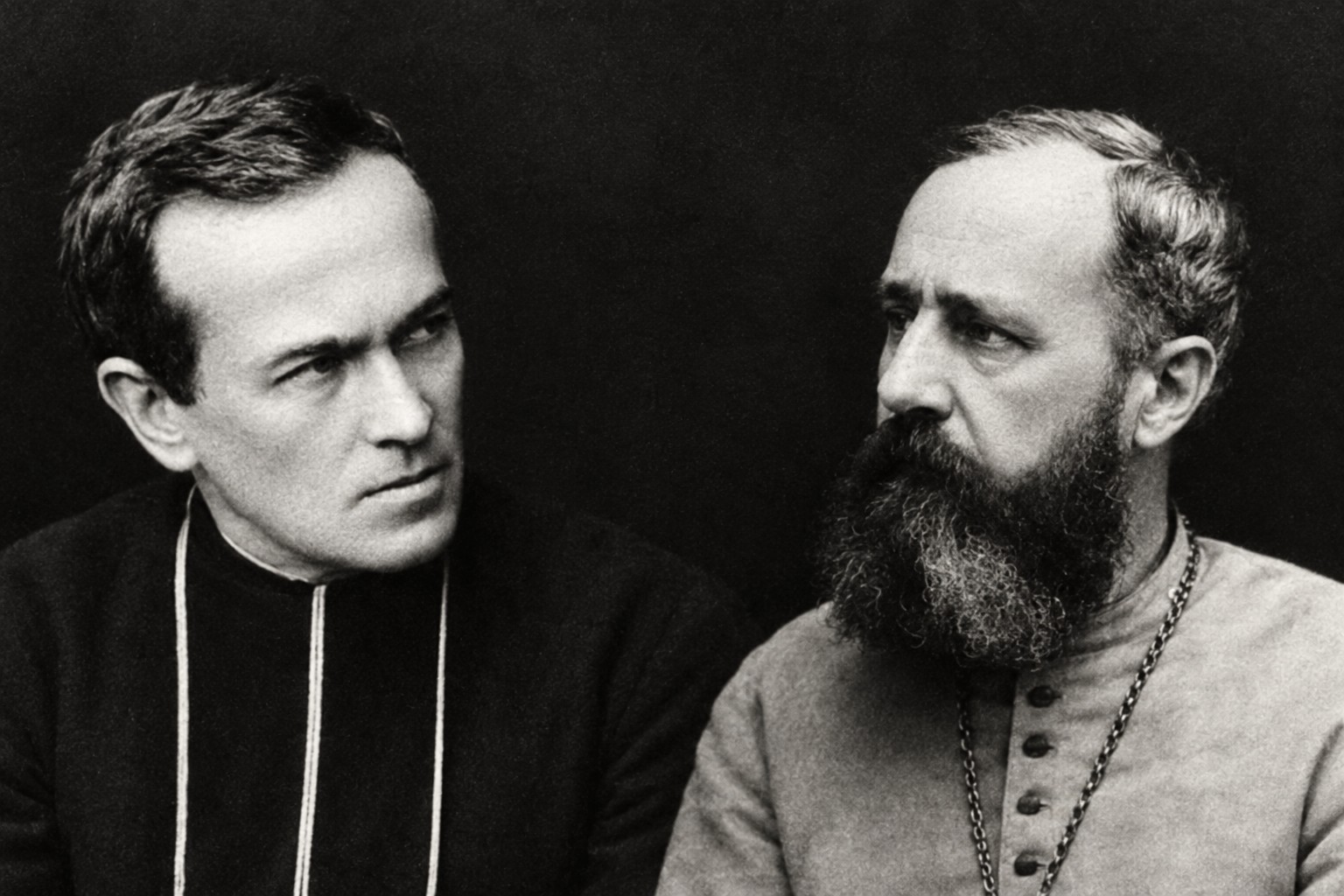
Bishop Gnonhossou’s words find a distant echo in a phrase spoken by the founder of the SMA, Melchior de Marion Bresillac, to his first missionary companions:
My work will last as long as there is a willingness to continue, and you will be that willingness.
— Melchior de Marion Bresillac, founder of the SMA
Bishop Francois Gnonhossou, sma, is Bishop of the Diocese of Dassa-Zoume (Benin). He was appointed bishop at the end of his term on the SMA General Council, where he served as the member responsible for formation in Africa. This interview was conducted on the sidelines of the SMA Plenary Council, May 26, 2026.
Leave a Reply