
When Ordinary Time Recalls the Essence of Missionary Leadership
By Pierre-Paul Dossekpli
SMA Plenary Council, Lagos 2026
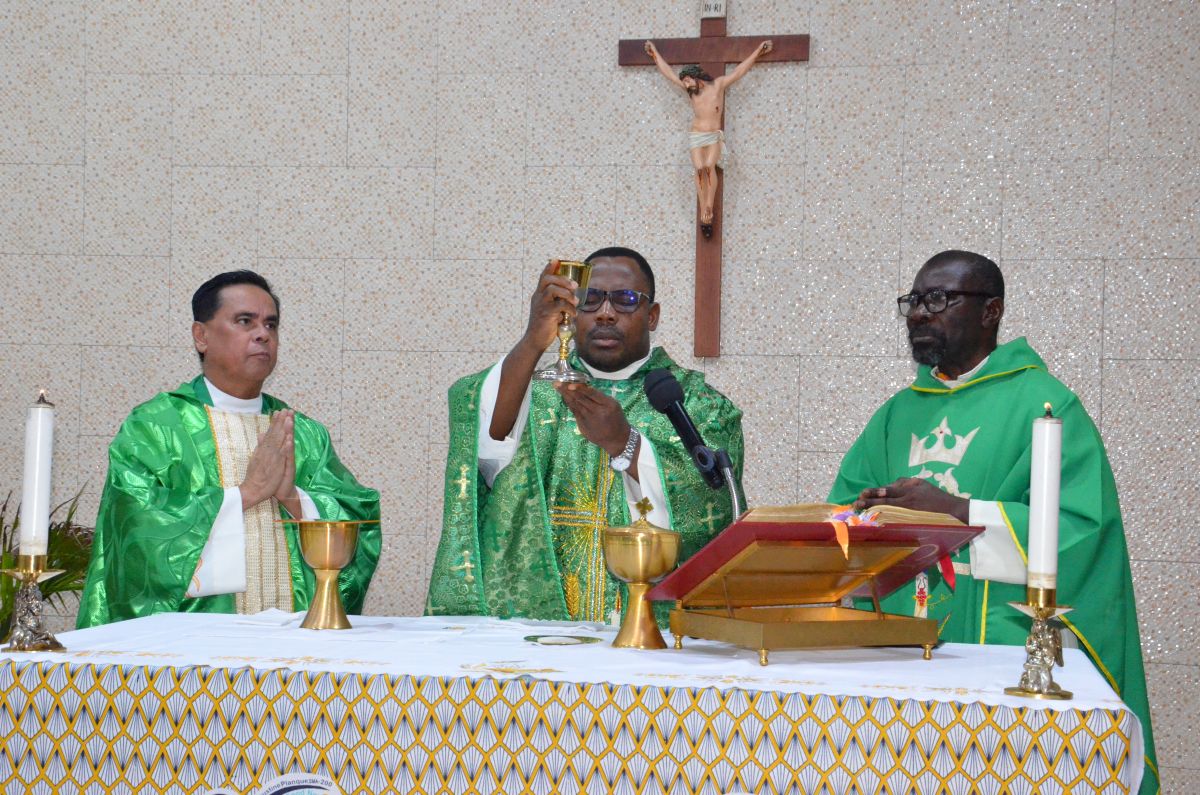
This evening, May 27, 2026, at 6 p.m., the Eucharistic celebration of the plenary council took on the green color of Ordinary Time. A discreet liturgical transition, but one full of meaning for those present. The Gospel proclaimed was that of Mark (10:32-45): James and John, sons of Zebedee, ask Jesus for the first places in his glory. His response refocuses everything: “Whoever wishes to become great among you must be your servant. Whoever wishes to be first among you must be slave of all.”
A word that fell at exactly the right moment. The SMA Plenary Council 2026 revolves around five major themes, one of which is good governance and synodality. And the day’s Gospel provided, from the very outset, its spiritual key.
Ordinary Time That Is Anything But Ordinary
Fr Robbin Kamemba, Provincial Superior of Kenya, admits he was taken by surprise when he arrived at the chapel: “It’s as if my head wasn’t there when I arrived; I was surprised to see it.” But he quickly made the connection with the work underway: “Ordinary Time, as the green tells us, is a time of hope, a time of waiting. But being at the plenary council, we know that not everything is ordinary. We must not fall into the ordinary, even if we are in Ordinary Time.”
For him, the green speaks something profound about this moment in the Society’s history: “Green is the color of hope, the color of sprouting leaves… The work we are doing will lead us toward that hope.”
Service: The Missionary’s First Agenda
Fr Malachy, Provincial Superior of Ireland, goes straight to the heart: “It’s got to do with humility and service — that’s our call. As missionaries, that has always been our main agenda. We came here to serve. To bring the Gospel to the local culture.”
With a frankness tinged with humor, he evokes the opposite temptation: that of seeing oneself as the “oga” — the chief — and expecting others to wait on you. “We come to serve people, not to be served. Truly, the one we need is the one who is willing to serve — not the one who wants to sit in a chair and say: ‘I am the chief, come and serve me.’”
And he concludes simply: “Serving is the big thing.”
Mission in the Small Things of Every Day
Fr Ceferino Cainelli, Superior of the Italian Province, who worked within the team responsible for the theme “Good Governance and Synodality,” connects the celebration directly to the heart of the council: “We have just celebrated the Eucharist, and we begin Ordinary Time. In the context of this plenary council, it reminds us that mission is lived in the daily life of our vocation, seeking to live our ministry as service in the small things of every day.”
He spells out what this means for those who hold positions of responsibility: “The Lord calls us to become his servants, exercising our responsibility and leadership as a service to our confreres, a service to the mission the Lord has entrusted to us, and the service of the Church in which we are.”
And he offers this conviction as a compass: “Living the Gospel in the small things of every day is, I think, the most faithful expression of the Gospel of Jesus Christ.”
Governance Measured by the Gospel
What these three voices say together, Pope Leo XIV’s recent encyclical, Magnifica Humanitas, formulates as a principle of faith. On governance in the Church, it states that “subsidiarity becomes a criterion of governance and pastoral life that recognizes and supports the responsibility of the faithful and intermediate ecclesial bodies, values charisms and competencies, and avoids all paternalism that stifles evangelical freedom” (Magnifica Humanitas, n. 87).
Far from being a purely organizational matter, good governance is therefore, in the Catholic tradition, both spiritual and concrete: an authority lived as service, decisions guided by subsidiarity and synodality, at the service of communion and mission. This evening’s Gospel was, once again, its most eloquent summary.
NB: Ordinary Time resumed on Monday, 25 May, after Pentecost Sunday. It is however only this evening that green vestments were worn, as the celebrations of the preceding days had required white.


Leave a Reply