
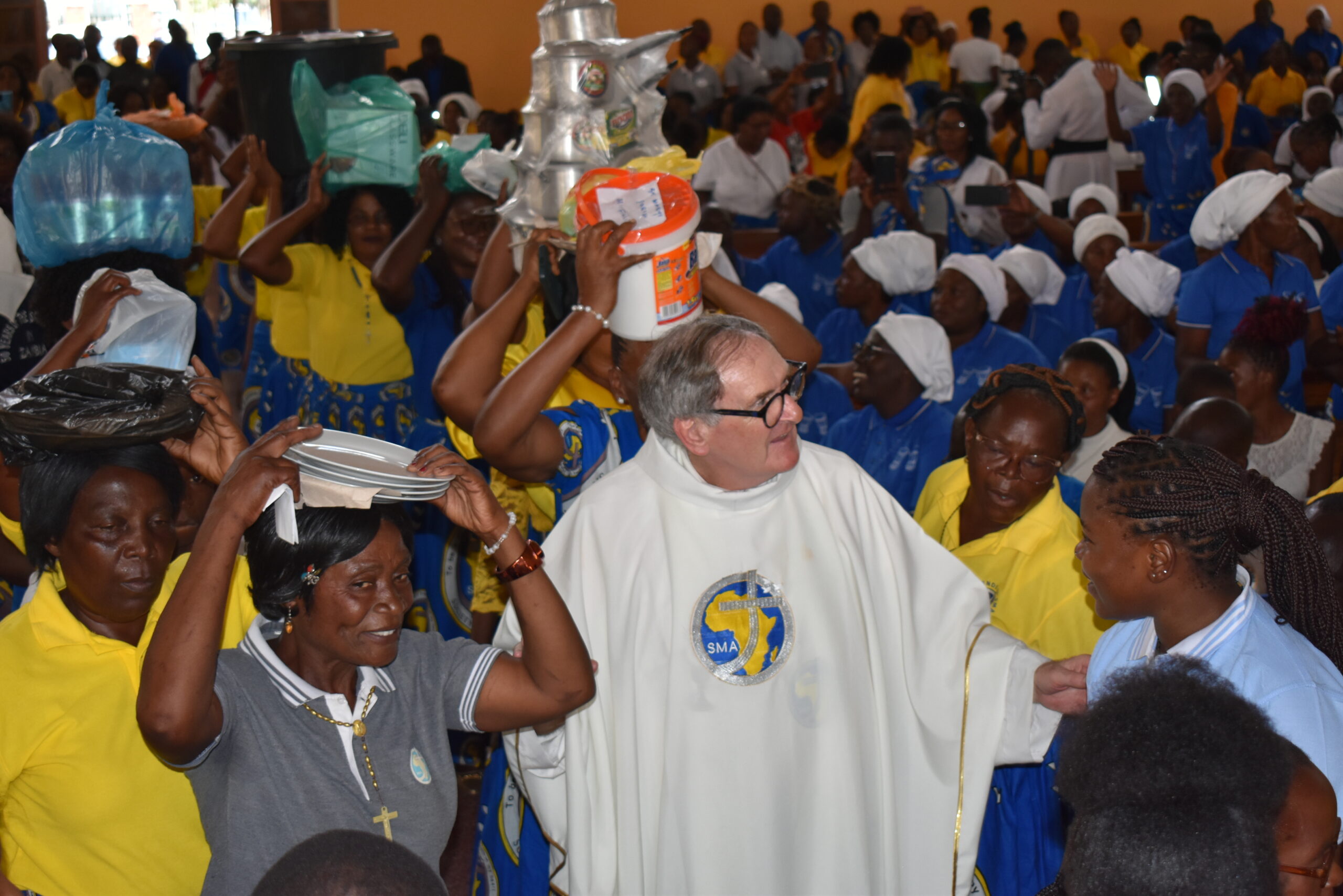
The theme of World Mission Sunday 2026, “One in Christ, united in mission,” invites the Church to renew her identity and commitment to proclaiming Jesus Christ. For the Society of African Missions (SMA) and the SMA Projects and Coordination Office in Rome, this theme raises an important question: how can development initiatives contribute to the missionary vocation of the Church without overshadowing the proclamation of the Gospel?
Development projects play a valuable role in promoting human dignity, addressing poverty, and improving people’s living conditions. However, when development becomes the principal institutional priority, there is a risk that evangelization—the very heart of missionary life—may receive less attention. Development and evangelization should not be competing priorities. Rather, development must serve the Church’s mission of making Christ known. In this article, I would try to give a missionary reflection on our various development activities in the light of the theme of this year’s World Mission Sunday Celebrations.
1. One in Christ: rediscovering the foundation of mission
In Redemptoris Missio (1990), St John Paul II affirms that the Church’s missionary activity finds its foundation in Jesus Christ and the salvation he offers to all humanity. In paragraph 44, he declares that “proclamation is the permanent priority of mission.” This teaching provides an essential reference point for the SMA’s engagement in development activities. Being one in Christ means allowing him to shape our institutional identity, priorities, and activities towards a common goal.
A missionary institution cannot measure its success solely by the number of projects it implements, the funds it raises, or the communities it serves. These achievements are valuable, but they must remain connected to the fundamental responsibility of proclaiming the Gospel. The SMA’s 2025 General Assembly, with its theme “Set apart to announce the Gospel in Africa, with Africa, and from Africa,” similarly calls the Society to remain faithful to its distinctive missionary vocation.
Based on the above, it is imperative that development initiatives emerge from a clear understanding of the SMA’s identity. Unity in Christ requires more than sharing Christian values or supporting humanitarian causes; it requires that the proclamation of Christ remains central to the institution’s purpose.
2. United in mission: development must not overshadow evangelization
The Church’s mission encompasses the proclamation of the Gospel, pastoral accompaniment, charitable service, and the promotion of human dignity. These dimensions belong together, but they are not interchangeable.
In Redemptoris Missio, particularly paragraphs 42–44 and 58, St John Paul II explains the relationship between Christian witness, human promotion, and the explicit proclamation of Christ. In paragraph 83, he warns against reducing missionary activity to humanitarian assistance and social development.
This teaching is particularly relevant to institutions that manage development projects. Funding opportunities, project administration, and measurable outcomes can gradually dominate institutional attention. Because development projects often produce visible results, they may receive greater recognition than evangelization, whose fruits are not always immediately measurable. Today on some our missions, our attention is much drawn to schools, health care, etc. to the extent Christian communities die out. Many projects reaching the office in Rome lack pastoral focus. In these situations, we can clearly see that development ceases to serve the missionary vocation and begins to determine it. If projects receive more attention than preaching, catechesis, pastoral accompaniment, and the formation of Christian communities, the balance of mission requires serious reconsideration.
3. The SMA’s missionary identity in relation to development
The 2025 SMA General Assembly’s call to be “set apart to announce the Gospel in Africa, with Africa, and from Africa” offers an important framework for reflecting on our place in the field of development. As we all know, SMA’s identity is fundamentally missionary. Its involvement in education, healthcare, social development, and other initiatives can express the Gospel in concrete ways. Yet these activities must remain integrated into the Society’s responsibility to proclaim Christ and support the growth of local Churches.
However, it must be emphasized that, these our activities or projects require asking whether priorities, resource allocation, and project evaluation adequately reflect the importance of evangelization. It also demands that we ensure that the administrative demands of development work do not prevent missionaries from devoting sufficient time and resources to their pastoral and evangelizing responsibilities.
Such reflection is not an argument against development. Rather, it is a call to ensure that development remains faithful to its proper place within the Church’s mission. My challenge as a missionary in primary evangelization set up has always been staying balanced – not replacing evangelization with development projects.
4. One Mission, different expressions: integrating evangelization and development
The theme “One in Christ, united in mission” offers a constructive way forward. Unity does not mean that every missionary activity must be identical. It means that different activities should contribute to the same fundamental purpose.
Development projects can address poverty, improve access to education and healthcare, and promote human dignity. Evangelization proclaims Jesus Christ, invites people into communion with God, and nurtures Christian communities. These activities can reinforce one another when they are rooted in a coherent missionary vision. I think for us SMA’s engaged in human development, this integration requires three commitments:
- Keeping Christ at the centre: institutional strategies and development initiatives should reflect the SMA’s fundamental responsibility to proclaim the Gospel especially the poor.
- Maintaining a proper balance: development activities should not marginalize pastoral ministry, missionary formation, or the explicit proclamation of Christ.
- Evaluating mission holistically: institutional effectiveness should consider both development outcomes and the contribution of its work to the wider missionary vocation of the SMA.
This approach respects the dignity and freedom of everyone served. Development assistance must never be conditional on religious participation or conversion. At the same time, the Church must remain faithful to her responsibility to proclaim Christ openly and respectfully.
In a summary, the World Mission Sunday 2026 celebration under the theme “One in Christ, united in mission” is an invitation to examine whether our priorities and activities adequately reflect the centrality of Christ and the proclamation of his Gospel.
Redemptoris Missio makes clear that human promotion and charitable services are important dimensions of missionary activity, but they cannot replace evangelization. Our development initiatives can make a significant contribution to this mission, provided they remain rooted in the SMA’s evangelizing identity. The objective is not to diminish development work but to ensure that it does not overshadow the proclamation of Christ.
Dennis Senyo Etti, SMA
Director – Projects and Coordination Office, Rome

Leave a Reply