
As Washington and Tehran attempt to ease tensions through a new memorandum, missionaries of the Society of African Missions describe a daily life already upended. Inflation, pastoral isolation, suspended projects: from Zambia to Burkina Faso, the repercussions of a distant war are reaching the most vulnerable parishes.
The signing of the memorandum between President Donald Trump and Iranian authorities has brought a breath of relief to diplomatic circles. Many see it as a sign of possible de‑escalation in the confrontation that has pitted the United States, Israel, and Iran against one another for months. But far from the capitals, in parishes across Africa and Europe, the consequences of the conflict are already tangible. For missionaries, a return to normal remains a distant prospect.
Modern wars strike first those who take no part in them: modest families, fragile communities, missionary priests whose only weapon is their daily presence. Members of the Society of African Missions (SMA) testify that geopolitical tensions cross borders and seep into even the most remote villages.
A distant war, but hunger close at hand
Long before the memorandum, the effects of the Iran–United States–Israel standoff were already being felt. Fuel prices rose, supply chains faltered, and humanitarian funding shifted toward conflict zones.
In Zambia, Fr. Mathias saw the war in Ukraine trigger a fertilizer crisis that crippled farming families. “The price of fertilizer has exploded,” he explains. One family even lost a son who had gone to study in Russia and was killed at the front — “their hope for a better future.”
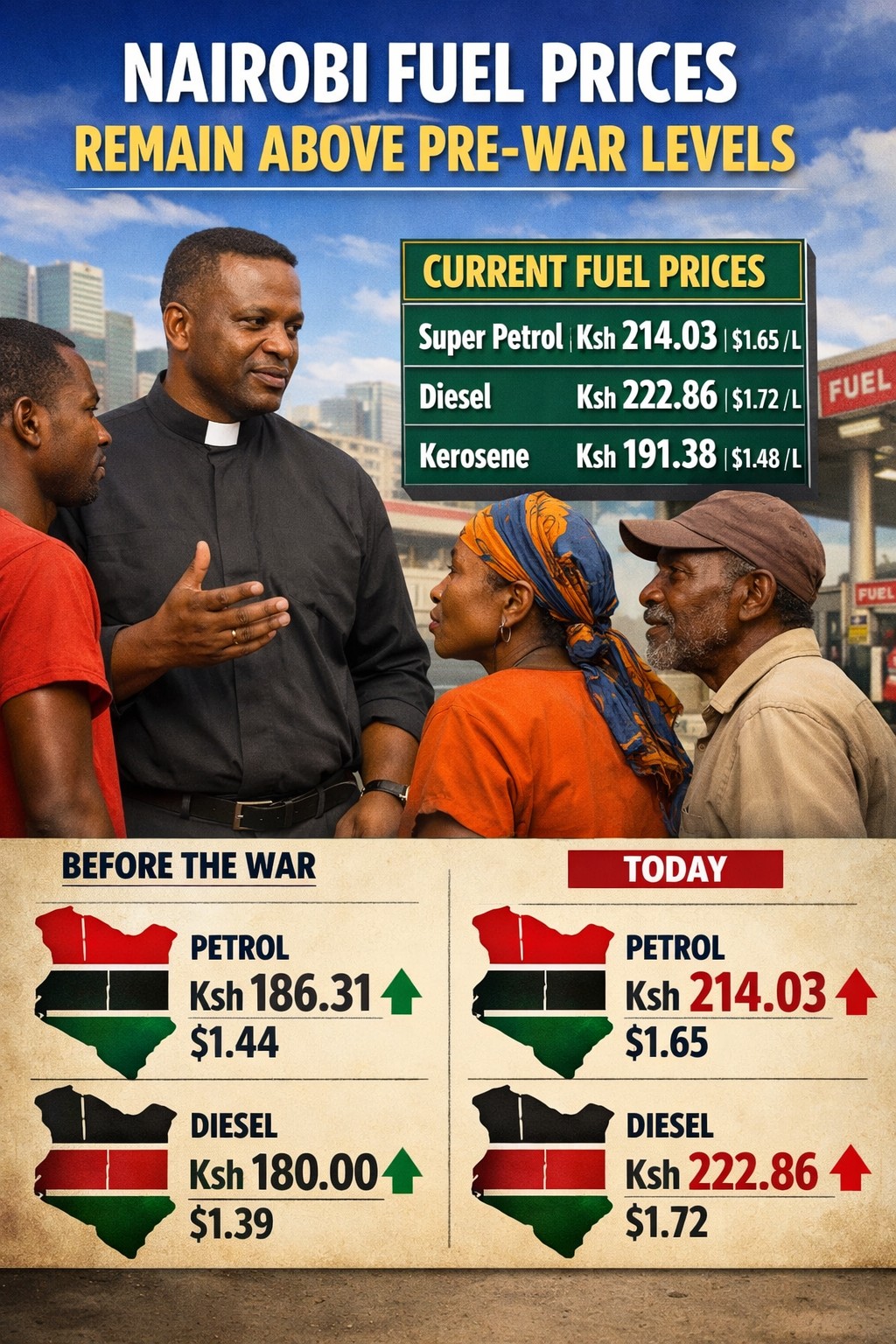
In Kenya, the rise in fuel prices has been dramatic. In Nairobi, petrol, diesel, and kerosene now sell for around 1.65 USD, 1.72 USD, and 1.48 USD per litre. Before the war, petrol cost about 1.44 USD; it later climbed to 1.70 USD. Diesel rose from roughly 1.39 USD to 1.69 USD. “Families survive, but barely,” says Fr. Godfrey.
In Burkina Faso, the situation is similar. “When fuel goes up, everything goes up,” notes Fr. Junior. Some families no longer eat three meals a day.
Even in France, Fr. Christopher observes the same inflationary spiral: “Many are giving up their holidays. The cost of living is suffocating.”
A pastoral presence under strain
When fuel becomes a luxury, mission work becomes more difficult.
In Kenya, Fr. Godfrey has reduced his travel. “I depend on small contributions from parishioners, but they too lack everything.”
In Burkina Faso, Fr. Junior travels long distances by bicycle to reach communities that have gone months without Mass. “A community without a priest is a community without life,” an elder told him.
Sharing from less
Poverty empties more than plates; it weakens social bonds.
In Zambia, Fr. Mathias notes a rise in individualism, crime, and the use of opiates.
In Kenya, communal meals after Mass attract more people than ever. “We share less, but we share more,” says Fr. Godfrey.
In Burkina Faso, Fr. Junior is categorical: “A community that is hungry cannot live together.”
Projects frozen, hopes suspended
Development projects have not been spared. Unfinished churches, redirected funding, exhausted donors.
“Uncertainty discourages,” says Fr. Mathias. “Support is decreasing,” adds Fr. Godfrey. “Expectations are rising,” concludes Fr. Junior.
Faith tested, yet standing
The crisis is also spiritual.
“Some doubt the love of God,” acknowledges Fr. Mathias. Others, paradoxically, find their faith strengthened.
In Burkina Faso, one family converted to Islam to receive aid — except for an elderly woman who refused. The Christian community took full responsibility for her care. “A sign of solidarity that honours us all,” says Fr. Junior.
A fragile hope
The memorandum will not erase the wounds. It will not bring down prices overnight. But it opens a breach — a horizon.
“There is no Easter without Good Friday,” recalls Fr. Mathias. “Life winds like a river, but it keeps moving.”
The missionaries did not choose this war. Yet they bear its scars. And now that diplomacy has opened a narrow door, they continue their work: walking, sharing, praying, supporting communities the world too often forgets.
Leave a Reply