
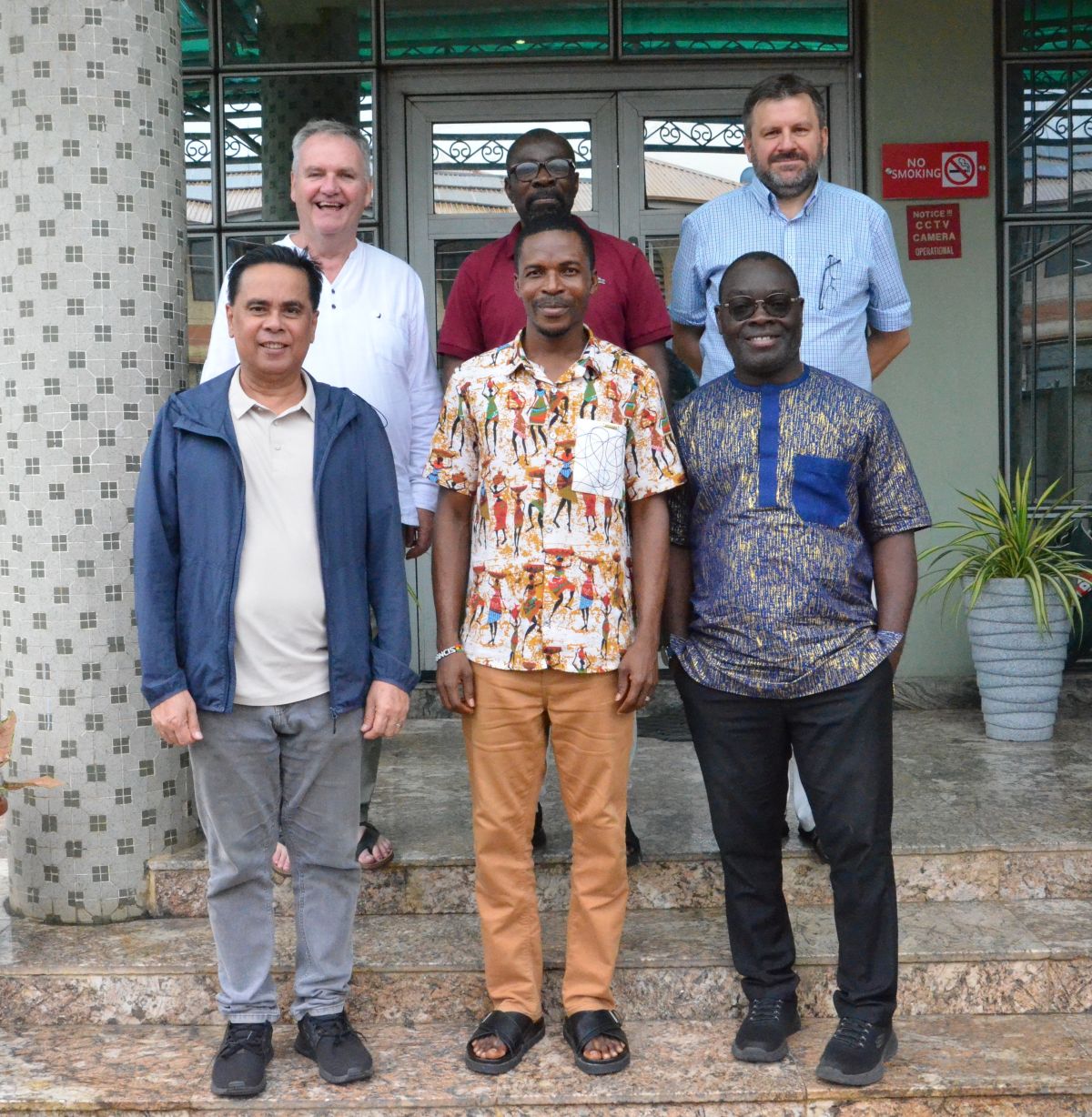
“What It Says on the Label Must Match What’s Inside”
By Pierre-Paul Dossekpli
SMA Plenary Council, Lagos 2026
During the 2026 Plenary Council, formation was at the heart of the conversation. In a world reshaped by technology, shifting charitable giving, and an increasingly complex mission landscape, how does the SMA ensure it is forming not just priests, but true missionaries?
SMA Media approached three members of the Council for an interview. Fr Damian Bresnahan, Vicar General of the SMA; Fr Dominik Waclaw, Provincial Superior of Poland; and Fr Dennis Etti, Director of the PACEM Foundation each shared their hopes, convictions, and challenges.
Their reflections come at a moment of real momentum: the SMA currently has 454 young people in formation across some 25 countries — a number set to grow further next year. Together, their voices offer a candid and inspiring window into what it means to form a missionary priest today.
A Missionary, Not Just a Priest
Fr Damian Bresnahan sets the tone early and unambiguously. The SMA does not simply produce ordained ministers — it forms men willing to give their lives entirely to mission.
“Our founder didn’t talk about priesthood — he talked about the missionary life. And that’s the call for all of us.”
That distinction is foundational. For Fr Damian, the missionary vocation is a specific calling — one that must be discerned honestly from the very start.
“What we want is to recruit young men who want to give their lives to the missionary life.”
But recruitment is only the beginning. For Fr Damian, what truly defines a missionary is a life rooted in prayer.
“We are preparing men of prayer — for mission, for mission. As one grandfather said at his grandson’s ordination in the Republic of Benin: ‘Now, my grandson, you are seen as a man of prayer. Always be a man of prayer.’”
This missionary identity must be cultivated from the very first stages. Pre-formation — the period before candidates even enter the seminary — is not a preliminary formality. “Knowing the people that we are welcoming into our communities is very important,” Fr Damian notes. “It was always a priority, over many, many decades, in all units of the SMA.”
Formation of the Whole Person
Intellectual formation, while essential, is only one pillar. Fr Damian insists it must be grounded in something deeper:
“The intellectual is very important. But if it is not supported by good spiritual discernment and human development, we don’t become angels — we are men who take on the role of working on mission. We are living in the world, so we must develop our humanity.”
Fr Dominik Waclaw, who works directly on integral formation, echoes this holistic vision and adds a distinctively SMA dimension: the cross-cultural immersion that begins early in formation.
“The fact that we are moving very early in our formation from one country to another allows us to learn other languages, other cultures, and opens us to a wider dimension of the SMA. It comes almost automatically from the very beginning — it is not something that happens once we are on mission.”
For Fr Dominik, who came to Africa as a seminarian rather than as a newly ordained priest, that early exposure was formative. “That was something very good,” he says simply. It is an advantage he sees SMA formation offering that many other congregations do not.
Integrity: Inside Must Match Outside
Perhaps no theme emerges more powerfully from Fr Damian’s reflection than integrity. He reaches for a vivid and memorable image:
“What it says on the label must match what’s inside the tin. It’s about integrity, integrity, integrity.”
The SMA is not only forming men who can perform priestly duties — it is forming men who are who they say they are. Men of prayer. Men who have dealt with their anger, their loneliness, their struggles before they ever set foot on mission.
“If I am angry as a seminarian, I will just be angrier on mission. We want happy missionaries, happy missionary priests, true to ourselves.”
Navigating a Digital World
No conversation about formation today can ignore the digital revolution. Fr Damian and Fr Dominik approach it from different angles — but their voices point in the same direction.
Fr Damian opens the door pastorally:
“The digital world, the world of technology — we must talk. It is a gift to the world. How do we use it as a gift? Rather than abuse it. Rather than become addicted to something that takes over our lives.”
Fr Dominik takes it a step further. For him, conversation alone is not enough. Formation houses, he argues, must cultivate what he calls “technological literacy” — a structured, deliberate competency. He draws a direct line from the Internet revolution to the rise of AI:
“It is difficult today, no matter where we are, to think about the future without being aware of the possibilities and at the same time the dangers of AI — in the same way it happened a couple of years ago with the spread of the Internet.”
Together, the message is clear: technology is not a passing distraction to be managed informally. It is a cultural reality that has its place in both the initial and ongoing formation of every SMA member.
Funding the Future of Mission
Quality formation does not happen without resources. Fr Dennis Etti, Director of the PACEM Foundation, sees this dimension clearly:
“We do not seek funds just for money’s sake, but for a greater vision — to form missionaries of quality for today’s world.”
The landscape of charitable giving is shifting, he observes. “People are always charitable, but not toward what they do not know. We must be foresighted.” Foundations like PACEM exist to ensure the SMA can sustain its missions even as the patterns of external support evolve.
“We must put things in place so that tomorrow, we can continue to support our missions ourselves.”
A Wonderful Calling
What unites all three voices is a shared conviction: the challenges are real, but so is the calling. Ongoing formation, Fr Damian insists, is not the responsibility of the institution alone — it belongs to each missionary.
“I am responsible for my ongoing formation. I must take that responsibility as a mature adult, moving forward to make a difference in today’s world as SMA missionaries.”
Fr Damian closes with characteristic directness, and characteristic warmth:
“It is a big challenge — it is not small. But it is a wonderful calling, a wonderful invitation. And with every invitation, with every opportunity, there comes responsibilities.”
For the SMA, those responsibilities are being taken seriously — one missionary, one formation community, one honest conversation at a time.

Leave a Reply