


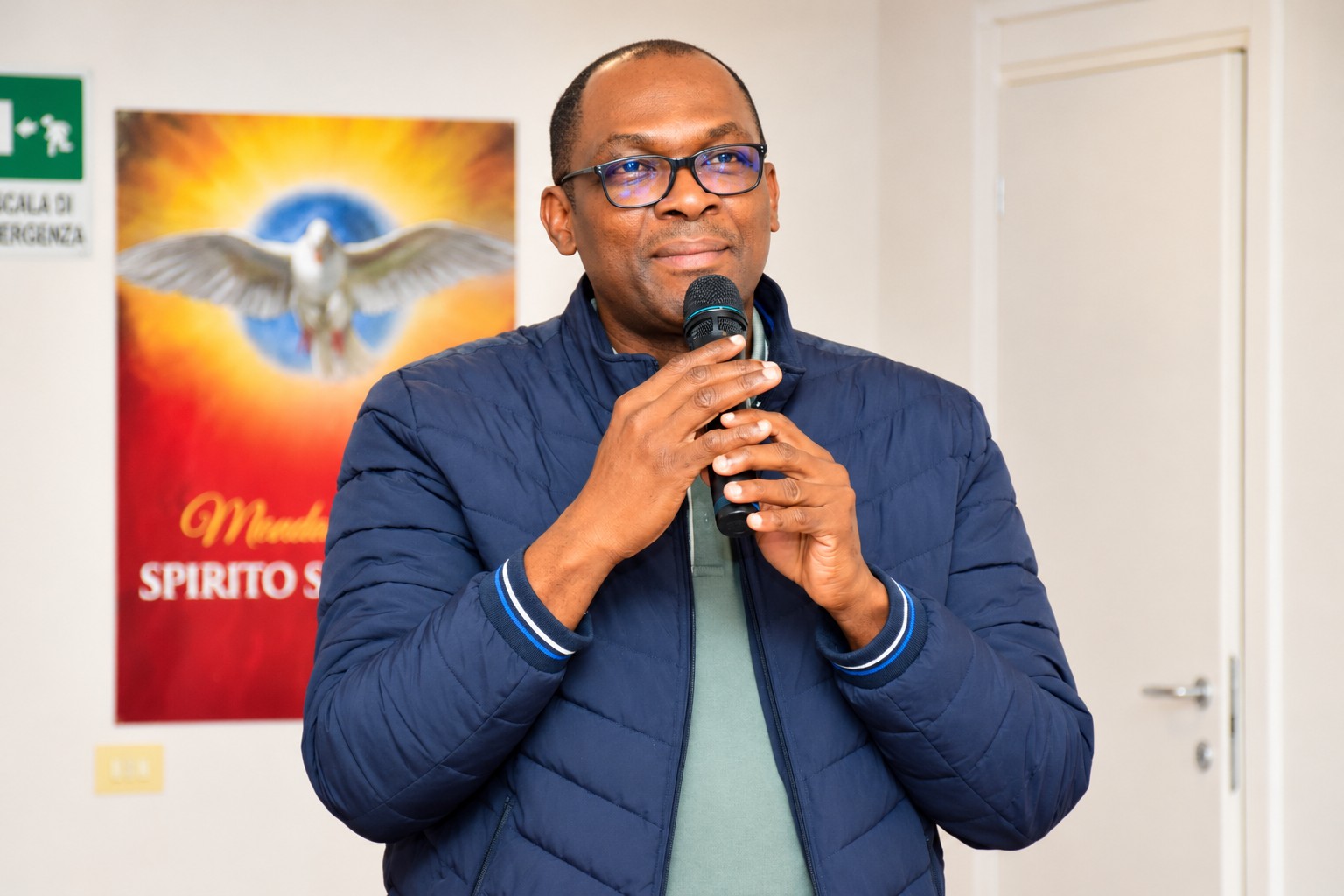
After six years leading the Society of African Missions (SMA) Province of Togo, Fr. Fabien Sognon is preparing for a new assignment in Kabwe, Zambia, where he will oversee the ongoing construction of the second International Spiritual Year. His journey brings together missionary formation, responsible governance and a commitment to building structures that will serve future generations.
How can missionary communities prepare for the future while remaining close to the needs of people today? For Fr. Fabien Sognon, this question has shaped six years of leadership in Togo and will continue to guide him as he prepares for his next mission in Zambia.
During his tenure as Provincial Superior, the SMA Province of Togo strengthened its institutional structures, developed local vocation formation and expanded its social engagement. Now, as he prepares to oversee the construction of the second International Spiritual Year in Kabwe, Fr. Sognon will draw on his extensive experience in financial administration, project management and missionary leadership.
His transition offers an opportunity to reflect on the lessons learned in Togo and the challenges facing missionary formation and administration across Africa.
Building a stronger missionary Province
Established in 2019, the SMA Province of Togo has spent its early years developing the structures needed to support a more autonomous missionary presence. Under Fr. Sognon’s leadership, efforts focused on strengthening its administrative, financial and pastoral organisation while preparing the Province to assume greater responsibility for its future.
One of the significant developments has been the opening of a propedeutic seminary in Lomé. Previously, young Togolese candidates travelled to Winneba, Ghana, for this initial stage of formation. The new structure enables them to begin their journey closer to home and strengthens the Province’s capacity to accompany future missionaries.
For Fr. Sognon, formation must go beyond academic and theological preparation. It should nurture the human, spiritual, intellectual and pastoral qualities needed by missionaries serving in an increasingly complex world.
Young SMA members must learn to engage with different cultures, enter into dialogue with other religions and respond to contemporary realities without prejudice or fear. Their preparation must also foster emotional maturity, fraternity, personal responsibility and the ability to work collaboratively with laypeople.
The growth in the number of seminarians and the confidence shown by diocesan priests who recommend candidates to the SMA are encouraging signs for the Province. Yet, the lasting success of vocation promotion will depend on the quality of formation and the ability to prepare young missionaries for the realities of the mission ad gentes.
When mission meets social need
The SMA Province of Togo has also broadened its engagement with local communities through initiatives addressing needs that extend beyond traditional pastoral activities.
The Ahonhon Neuropsychological Centre is a notable example. Initially conceived to support adolescents experiencing distress, particularly in connection with family difficulties, the centre has expanded its work in response to growing demand.
Its services now address cognitive difficulties affecting people of different ages, including problems with memory, attention and concentration. It also supports older people experiencing cognitive decline, including conditions associated with Alzheimer’s disease and dementia, as well as people recovering cognitive functions following trauma or a stroke.
This development reflects a wider understanding of missionary presence: responding to human suffering through specialised care, professional competence and respect for human dignity.
The Province is training confreres to contribute to this work, with further training planned. It is also developing the foundations of Maison Matusalén, an initiative intended to accompany older people facing isolation and the challenges of ageing through human, spiritual and therapeutic support.
Together, these projects illustrate how missionary institutions can remain faithful to their spiritual identity while responding creatively to emerging social needs.
Financial responsibility as a service to mission
Behind every missionary initiative lies a practical question: how can it be sustained?
The Province of Togo continues to work towards greater financial autonomy by strengthening local capacities, encouraging responsibility among its members and exploring income-generating activities. Nevertheless, achieving self-sufficiency remains a long-term challenge as the needs of communities and the costs of maintaining missionary works continue to grow.
Fr. Sognon brings considerable experience to this question. His previous financial responsibilities extended across missionary structures covering as many as sixteen African countries. Working alongside experienced SMA confreres, he learned that financial administration must be understood not simply as accounting, but as a responsibility directly connected to the Church’s mission.
“Financial management is not an end in itself, but a pastoral ministry and an instrument directly serving the mission,” he explains.
This approach places transparency, accountability and careful planning at the heart of administration. Every resource entrusted to a missionary institution must be used for its intended purpose, whether that is formation, education, healthcare, pastoral work or social development.
It also calls for a shift from simply covering expenses to investing in projects capable of producing lasting benefits. Diversifying funding sources, building reliable partnerships and developing local expertise are essential if missionary works are to become less dependent on external assistance.
For Fr. Sognon, sustainability is not exclusively financial. It is also human, institutional and pastoral. Projects must be supported by competent people, clear governance structures and the active participation of the communities they are intended to serve.
These principles are particularly relevant to his forthcoming assignment in Zambia.
From financial administration to construction supervision in Zambia
In Kabwe, Fr. Sognon will oversee the ongoing construction of the second International Spiritual Year, a project linked to the preparation of future missionaries. His new responsibility will draw on his experience in financial administration, project management and the supervision of construction projects.
For him, a construction project cannot be managed through financial resources alone. It requires a clear vision, careful preparation, qualified professionals, transparent budgeting and regular monitoring of the work.
Planning must begin with a precise understanding of needs, reliable architectural plans, a realistic assessment of costs and a clear timetable. Choosing contractors and suppliers should involve more than comparing prices: competence, reliability and the quality of the proposed work are equally important.
Once construction begins, regular site visits and close monitoring are essential to verify materials, workmanship and progress. Proper documentation—including contracts, plans, invoices, technical reports and records of decisions—also helps protect the project and provides a reliable basis for future maintenance and development.
These practices are especially important for missionary institutions, where resources are entrusted to the Church for purposes that extend beyond the present generation.
The International Spiritual Year is not merely a construction project. Its lasting value will lie in its contribution to the formation of missionaries and the service they will offer to communities in the years ahead. Ensuring that the building is completed responsibly and can serve its intended purpose is therefore part of the wider mission.
A changing mission requires new approaches
Fr. Sognon’s reflections also point to the broader challenges facing the SMA in West Africa and beyond. Young populations, rapid urbanisation, digital technologies, unemployment, social inequalities and insecurity are changing the environments in which missionaries work.
In some regions, conflict, violent extremism and forced displacement add to the difficulties experienced by vulnerable communities. Missionary engagement must therefore bring together evangelisation, education, human development, interreligious dialogue and peacebuilding.
Young people, in particular, must be reached where they live, study, work and communicate, including through digital platforms. At the same time, missionary formation must prepare candidates to work alongside local churches, other religious congregations, civil society organisations and communities of different faith traditions.
Fr. Sognon also emphasises the importance of collaboration between SMA Provinces and the greater involvement of laypeople and young people in missionary initiatives. The future of the mission, in this view, depends not on a single institution doing everything, but on building partnerships, sharing expertise and enabling local communities to take greater responsibility.
The Province of Togo’s communication initiatives, including SMA-TOGO TV and the Atopani-228 magazine, form part of this effort to make the mission more visible and strengthen connections with families, young people and lay associates.
The historic collaboration between the SMA and the Sisters of Our Lady of Apostles (NDA) in Togo remains another expression of shared missionary responsibility. Their common history, dating back to the mission entrusted to both institutes by the Holy See in 1921, continues to offer a model of collaboration rooted in a shared charism.
Leadership that prepares the next generation
One of the central lessons Fr. Sognon draws from his years of leadership is that good governance is not about concentrating responsibility in one person. It is about building trust, encouraging participation and preparing others to carry the mission forward.
Leading communities across different cultural and institutional contexts requires listening, dialogue and a shared vision. It also requires the ability to evaluate projects honestly, learn from experience and adapt to changing circumstances.
These principles apply equally to partnerships with local organisations. Rather than maintaining relationships based solely on external assistance, missionary institutions are called to work alongside local partners from the beginning, share knowledge and establish structures that can become increasingly autonomous.
For the SMA, this means continuing to invest in formation, strengthening interprovincial cooperation, promoting social justice and ecological responsibility, and preparing missionaries for the pastoral and technological realities of the present day.
Such an approach seeks to ensure that the mission remains both faithful to its founding charism and responsive to the needs of contemporary society.
Building for a mission that lasts
As Fr. Fabien Sognon prepares to move from Togo to Zambia, his experience brings together two dimensions of missionary service: developing people and building the structures that enable them to serve.
His years in Togo have highlighted the importance of strengthening local vocations, extending social engagement and developing responsible systems of governance. In Kabwe, these lessons will inform his responsibility for overseeing the construction of the second International Spiritual Year.
The challenges ahead are real. Financial autonomy takes time, social needs continue to grow, and construction projects demand careful supervision. Yet, these challenges also offer an opportunity to rethink how missionary institutions plan, collaborate and prepare for the future.
Ultimately, the measure of a missionary project is not simply the building completed, the funds managed or the structures established. It is the people formed, the communities served and the capacity created for the mission to continue.
For Fr. Sognon, the task ahead is therefore part of a larger commitment: to ensure that resources are used responsibly, that future missionaries receive sound formation and that the SMA continues to bring the Gospel to those most in need—with humility, competence and a vision that extends beyond the present.
Leave a Reply