


Angola is one of least known countries in the SMA world. I visited our missions in the country from the 10th to 20th of October 2016. I would share briefly with everybody here the whole project of Angola.
- Presentation of Angola
Brief history of the country
Angola became a colony of Portugal in the 15th century and gained independence in 1975 after about 14 years of war with the colonial power. Instead of peace and prosperity the independence gave another war, an internal one which was longer and more devastating. It ended in 2002 immediately after the death of Jonas Savimbi. From that time onwards, Angola is walking slowly towards some kind of a democracy.
History of the SMA
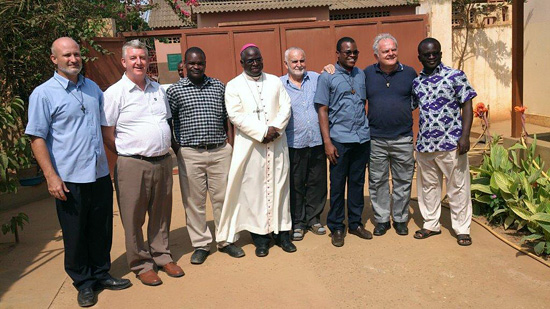 SMA has been working in Congo from 1952. The mission of Kikwit is close to the northern border of Angola and the missionaries crossed the border many times since then for various reasons. The mission of Angola itself was started in 1999 by our Italian confreres. Since 2011, Df members started going to Angola. Today we have three missions and nine SMA missionaries – four from the province of Italy and two from Gulf of Guinea, two from Great lakes and one from Bight of Benin. Ceferino Cainelli from Argentina is the superior of SMA Angola now.
All our missions are in the diocese of Caxito in the capital city Luanda. The capital city has eight million people which is about one third of the total population of the country.
SMA considered promotion of local clergy as the top priority from the very beginning. Many vocations for the diocese and other congregations have come from our missions. We decided to accept seminarians from Angola recently and now we have four doing philosophy in the Regional seminary together with diocesans.
The official language is Portuguese.
SMA mission at present
Bom Pastor: Jacques-Alain MAHUTIN, the parish priest and Ceferino CAINELLI, Etienne NGUESSAN and Renzo ADORNI as assistants serve in Bom Pastor. Plenty of activities go on in the mission.
I was speechless to hear that they had over four hundred catechists in the parish that has six chapels and over thirty prayer centres. The number of children and youth is phenomenal not only in this parish but all over the country. Our priests also play quite a few key roles at the diocesan level.
Santa Isabel: Angelo BESSENZONI was the Parish priest till recently. Felix NAMUSONGE is the leader of the team now joined by Apollinaire KAKHANDA and Chukwubuikem NWOHA.
 The parish had a minor robbery early this month. About five or six armed men entered into the campus and opened many locked doors without breaking them. As one of them was removing the car radio he happened to touch the horn and our men woke up. The robbers then rushed out without entering into the presbytery before the Police came. They stole certain things like a refrigerator from the rooms outside the presbytery.
Nossa Senhora da Assuncao: Walter Maccalli works in this rural mission. He is to some extent restarting the Church in a place that still bears all the marks of a war that scattered the population. An old store house is getting transformed into a Church and presbytery. Walter, being a carpenter himself, has done quite a good bit of work himself to create partitions in the big hall and has carved out a chapel, an office and other rooms.
Three sisters have just come to the mission. Their main vision is to found a maternity in order to respond to high mortality rates during delivery in this area. The essential work of the building is already over and it will still need some finishing touches and furnishing. The major challenge comes from the government. The mission has no authorization yet to have a maternity. They will work initially as an ordinary dispensary with a pharmacy hoping to open the maternity soon.
The pastoral team includes Alexandra, a lay missionary from Portugal who has been in touch with this mission for the past number of years.
- General impressions
The community of Angola is founded on a very good base.
- Members believe in community life. They pray together before lunch and supper.

- SMA has responded to the main need of the diocese in line with our charism by promoting local clergy. There is a systematic programme to accompany young people in their vocational discernment. Most of the Caxito diocesan priests come from the SMA missions.
- Our members value youth ministry and are deeply committed to it in their missions and one of them is a diocesan youth coordinator for years.
- They lead a simple and sustainable life-style.
- The places where our members serve are those that really need missionaries.
- Angola, in spite of all problems, is growing fast and the government is working seriously. There will be a strong middleclass in the near future.
- The government is investing a lot in education. Missions run schools. The same building is used for two or three shifts since students have only four hours of class every day. Educated people have great demand in the job market.
- Insecurity is the biggest challenge in the urban missions.
- Due to the fall of oil prices, US dollar costs more than three times the official rate in the open/black market.
- Due to high population density and low landscape, rains make life difficult in every sense. If stagnant water for days and weeks is bad enough on roads, we need not mention when it is inside houses. The city is still battling with the herculean task of garbage collection. People have just finished burying the victims of a yellow fever epidemic and they feel helpless as dark clouds gather announcing the next rainy season.
- All our missionaries serve in the diocese of Caxito and they would prefer to spread their wings to interior dioceses.
- Vision for the future
Vision of the Bishop of Caxito
Ceferino and I met the bishop of Caxito. He has high praises for the SMA contribution. Asked of the priorities of the diocese, he said the following:
- Youth ministry: Luanda has 8 million people now. Some thought that the people would go back to their provinces after the war but we see more
 people coming to Luanda from the interior. There is an explosion of population after the war. The country has plenty of children and youth. They will grow far greater in number in the coming years. We will need to concentrate on the ministry of children and youth.
 - Catechesis: There is a big need for catechesis at all levels. Priests need to teach catechism, train catechists, provide ongoing formation for them and coordinate programmes and publications on catechesis.
- Presence: As the city is expanding fast, it is a big challenge to be present wherever people are. Various sects proliferate and people go to them especially where we are not present. The diocese wants to open one new parish every year.
- Ministry for women: There is a bigger number of women in the society and in the Church. We need to address their pastoral needs.
Future of the SMA in Angola
 SMA will continue to work for the priorities of the local Church. The community of Angola will need a few more members in the coming years.
SMA has three seminarians in Second year philosophy and one in First year. The seminarians were accompanied by SMA fathers for a few years before they entered the seminary. All SMA priests of the community visit the seminarians and have half a day of ‘SMA work’ with them once in two months. It is a very strong commitment from the SMA confreres since the seminary is over 400 kms away from the SMA missions.
Students from Angola speak Portuguese and need to learn English and French though they have some English from school. One advantage is that the academic year corresponds with the calendar year, which means they begin in February and finish in December. After finishing Philosophy, our Students will have enough time from January to September to master both English and French somewhere in West Africa before starting their Spiritual year.
With the growth in population and the developing middle class, the country will not lack vocations and SMA Angola can attain self-sufficiency more easily.
The land is vast teaming with life. Formation of the society in every sense is the overall goal of the Church and the government. Our main mission will be the continuous discernment of priorities in the country where opportunities and invitations are endless.
S. I. Francis Rozaio, SMA
Leave a Reply