

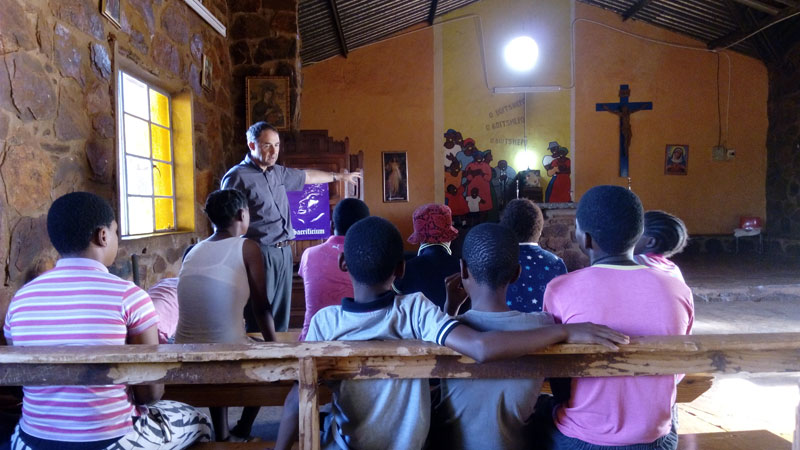
Fr. Martin Walsh, teaching weekly catechism to a group of children
I visited the base of the African continent, South Africa, from March 2 to 10, 2016. I extend my sincere thanks to Fr. Pius Afiabor, the Regional Superior and all the confreres for the warm welcome I received. As it was my first time coming to the country, I learnt immensely and discovered the joys and challenges the pastoral terrain offers to missionaries. The bishops of Rustenburg and Pretoria enlightened me with their perspectives.
Here are the main points that concern the South African mission.
1. Neutrality Though apartheid ended officially, it will take a generation or two to rebuild the society. Comments on race show up in conversations as a matter of fact. SMA confreres come without the baggage of the South African past and that makes them neutral. People of all races accept them more easily. African migrant community is growing in numbers in many parts of South Africa. Tension builds up in the relationship between African migrants and South African black people due to real or perceived danger of an employment crisis. Even in this context, the presence of SMA confreres proves to be a great blessing. Many of our confreres feel the importance of community life. They can offer a great service through the witness of a fraternal international community in a country that dreams of such a mixture while battling with past wounds.
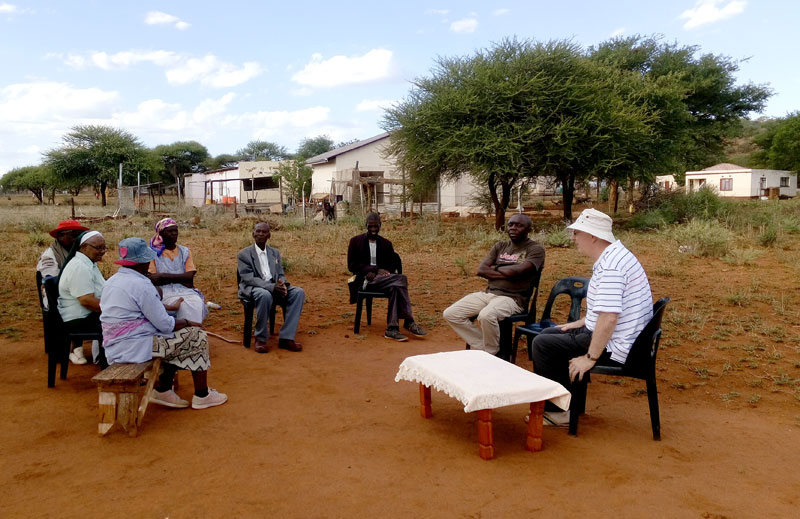 Fr. Noel Gillespie with the community in a village that comes for ongoing formation
2. Faith formation The bishops of Rustenburg and Pretoria talked of faith formation as the top priority of the country. The South African Church concentrates on faith education which goes beyond preparation for sacraments. I came across mainly three running programmes. They are RCIA, Young Adult faith formation and Renew Africa. I observed with delight how our confreres believe in the priorities and are actively involved in both teaching and training teachers. A missionary acts both as a teacher and a coordinator of teachers. He ensures quality while teaching and assures quantity while coordinating. Only through solid adult faith formation can we face the most crucial pastoral challenges.
3. Family The past apartheid system and the present mining industry seem to have destroyed the family fabric in the society. Miners live in hostels meant only for men and many go on holidays to their home place once or twice a year. The society faces devastating consequences. According to statistics only three out of ten children live under the same roof with their fathers. If you want to be polite and do not want to embarrass others and be embarrassed, avoid asking about the father. The number of people with HIV is sky rocketing. Childhood pregnancies terminate the education of many girls. Children grow up with grandmothers while the mothers go to towns and cities either for education or work. Since AIDS took their guardians away, many children live in houses without any adults around – vulnerable. The sacrament of marriage appears to many as too exotic. The South African Church calls us, missionaries, to focus on this dimension, build targeted programmes together with the local Church and remain committed to them for the coming decades. This resembles planting olive trees for the coming generation to reap fruits.
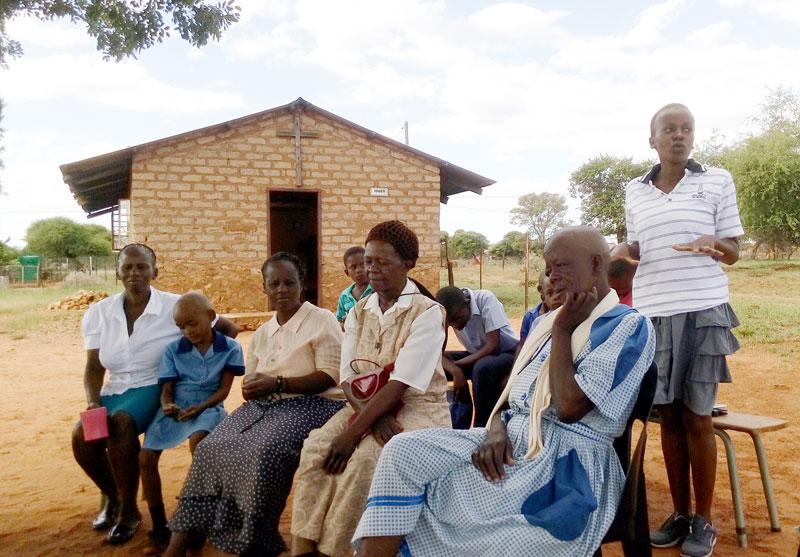 A young lady explains the ‘Young Adult faith formation programme
4. Church leadership The apostles preached the gospel and established deacons, elders and bishops in the early Church to succeed them in serving the Church. Missionaries work on their succession plan from the time of their arrival. What kind of a vision do we see emerging in South Africa? Marriage and celibacy support each other and when one is hurt the other feels the pain. Formators and bishops see the struggles of the vocation to celibate priesthood. Many candidates either leave before ordination or during the first few years after the ordination. The Church leaders are convinced that the starting point is not vocations promotion but building families. Meanwhile bishops see permanent deacons as part of the solution. Due to long distances between churches and the scarcity of priests, lay leaders play a vital role in many places. Many missionaries might come from a highly priest centred Church and society. They could easily see centralising everything around the priest as a step forward without realising the risk of reversing the already achieved development of the South African Church in lay leadership. For various ministries, in the present context, missionaries need to see permanent deacons and lay leaders not only as their immediate collaborators but also as their possible successors.
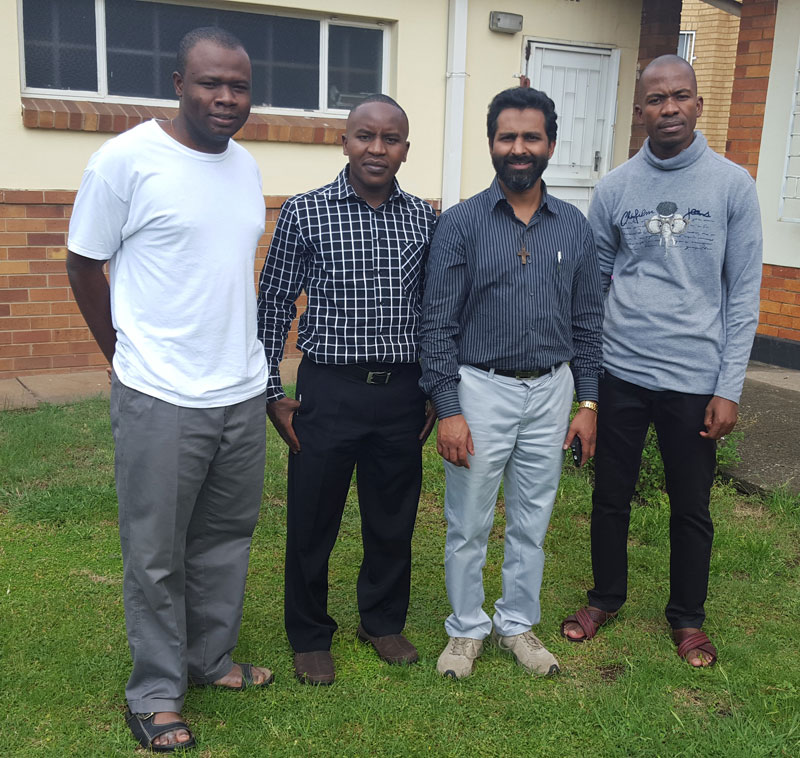 The team in Vereeniging, Johannesburg. Left to Right: Dim Emmanuel, Samuel Munyi, Francis Rozario, DENOUKOUIA Gonsan Henri
5. Choice of missions Our members are working in three dioceses. The diocese of Rustenburg has mostly rural missions, very few diocesan priests and no seminarian. The other two dioceses, Pretoria and Johannesburg, are different. We value our presence in all three dioceses. It gives us the variety we need. Practically speaking, we acknowledge that rural missions demand more financial backing. We need to take the number we can realistically manage. Being self-sufficient, urban missions do not weigh on the sending Units and in some ways can even share the burden of the Units by supporting rural missions. Support networks are created in urban missions. It was a great pleasure for me to meet some budding groups as a result of our confreres’ initiatives. They can be a great missionary power. As we try to strike a balance between risking and being realistic, we keep closer to our hearts the places that need us most. Who can choose them if not missionaries? 6. SMA lay missionaries: The numerous social challenges offer pastoral opportunities to our SMA lay missionaries. We can explore possibilities of some projects with long term commitments. I saw and heard, throughout my stay, South Africa paying genuine and generous tribute to the SMA contribution. Beyond any doubt, we stand on a solid history built by our men serving hand in hand with the local Church over the years. We see the depth of their commitment in their stability in the mission country, their mastery of local languages, and their close collaboration with bishops. South Africa will need us and our charism for a long time to come. Exciting and fruitful decades are ahead!
S. I. Francis Rozario, SMA
Leave a Reply