
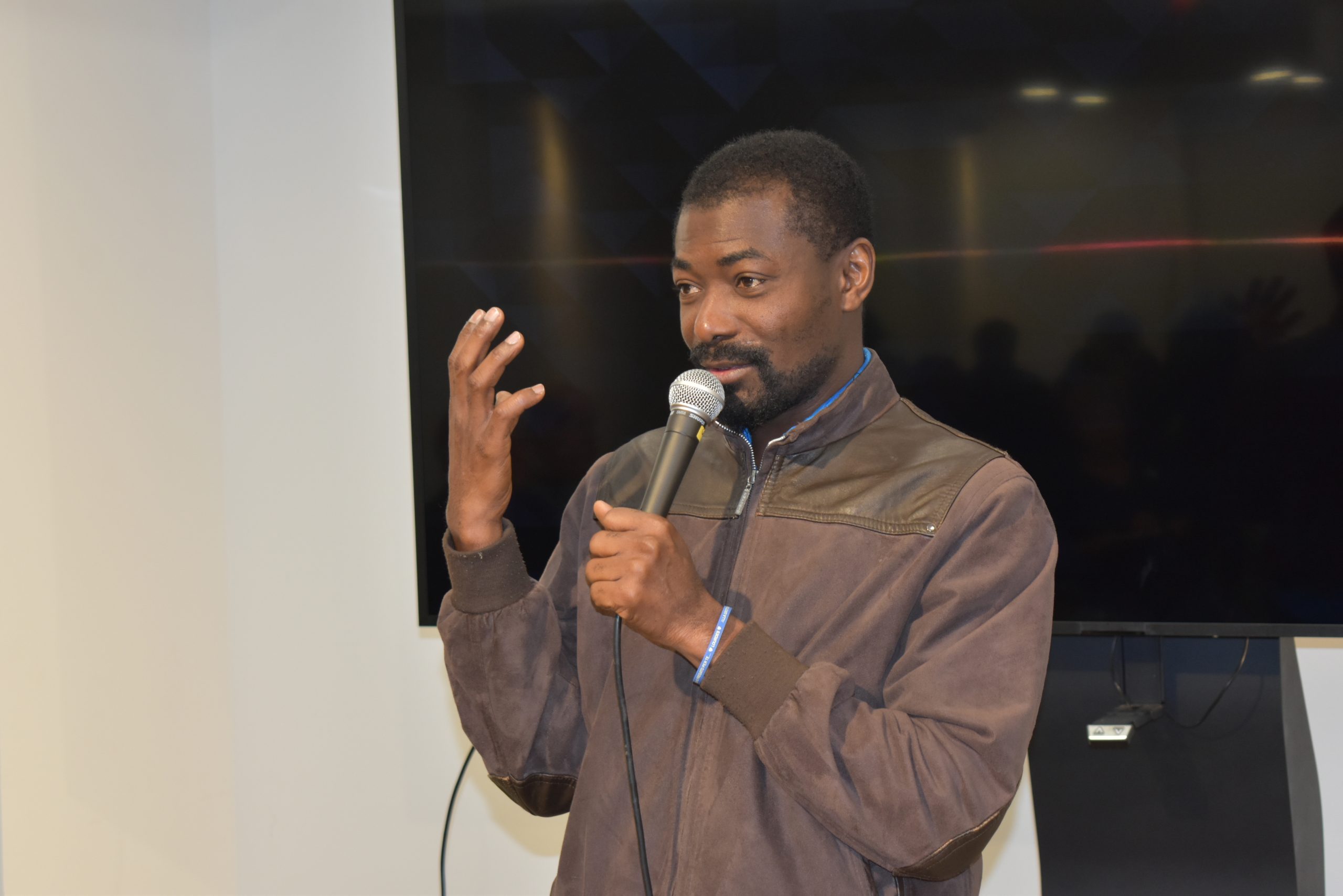
After nearly thirteen years in Lyon, Father Jean Paul K. is preparing to return to his native Togo. A missionary priest of the Society of African Missions (SMA), he leaves behind much more than an office or a community house — he leaves a deep mark of dialogue, culture, and fraternity. Between his leadership at the Carrefour des Cultures Africaines (CCA) and his service within the (Maison International Missionaire) MIM community in Lyon, he has embodied a living bridge between two worlds — African and European — where ministry becomes encounter, listening, and mutual learning.
When he looks back on his twelve years in France, Father Jean Paul doesn’t speak of adaptation, but of transformation.
“I’ve simply realized that, whether we like it or not, the presence of others in our lives reshapes our way of living and functioning,” he says.
Navigating between two cultures has revealed to him the fluid nature of identity: “We don’t really have a fixed identity. Our identity is what life gives us each day… because our true identity is love — love that has neither color nor civilization.”
In Europe and in Africa alike, the priest’s role is perceived differently, yet for him, it is precisely within that difference that the beauty of priesthood lies — a ministry of presence and self-giving that knows no borders.
The ministry of objects: when artifacts speak
At the Carrefour des Cultures Africaines, his mission was never simply about “preserving the past.”
“Taking care of an African artwork,” he explains passionately, “is a way of taking care of today’s humanity.”
Each mask, each sculpture, for him, is a library of peoples, beliefs, and traditions.
“Every exhibition becomes an encounter, and from that encounter, dialogue is born.”
Under his direction, the museum became a vibrant space where culture became prayer, and art spoke the universal language of human dignity.
Building bridges: “every human being Is a communication”
To speak of Jean Paul is to speak of bridges. “There is no such thing as a bridge too hard to build,” he says with calm conviction.
What makes connection difficult is not difference, but the lack of willingness, dialogue, or understanding. “The very fact of talking and exchanging — even without agreeing — is already a bridge. Every human being is a communication.”
In a cosmopolitan city like Lyon, he learned to weave ties among cultures, churches, institutions, and peoples — always grounded in the simplicity of daily life.
Leadership lessons at the MIM: “becoming a mirror through humility”
His years of leadership at the MIM community profoundly shaped him.
“One must simply and humbly become a kind of container that serves as a mirror for others,” he says with an image that’s both disarming and profound.
For him, to lead is to welcome, to forgive, and to turn wounds into collective growth. “Diversity is a gift… Accept each person as they are and help them see that when you dirty your own clothes, you don’t hurt the one wearing them, but the one who washes them.”
Humor, humility, and humanity — three hallmarks of his style of leadership.
The lesson of delay: when waiting becomes formation
Before Lyon, there was Togo — a rural parish, a mission of patience.
“I didn’t want to come to France right away… When I didn’t get the visa in 2012, I served a year in a rural mission in Togo. I don’t regret that experience.”
That “setback” became a school of patience and trust. “Learning from ordinary people, speaking their language, trusting their rhythm — that helped me later in France, in a multicultural missionary setting.”
The evolving Mission: presence, listening, and hope
For Father Jean Paul, the role of a missionary society in Europe remains the same at its core: to proclaim Christ, especially to the forgotten and the wounded.
“We must accompany the elderly, reconcile families, and help the Church in France to better welcome Christians from elsewhere.”
Amid cultural fractures and social fatigue, he insists: “Our presence, our listening, and our support — these are forms of hope.”
Community as formation: het school of living together
Thirteen years of community life have shaped him more deeply than any course or assignment.
“Community is a living school of formation… It teaches us to welcome one another and to receive from others the grace of living together.”
For him, fraternity itself is the first missionary field. “A leader must learn to find joy in pain — to make the Beatitudes come alive in community life.”
Partnership and collaboration: love as the face of God in action
His ministry in Lyon was also marked by collaboration with civic, cultural, and political partners.
“Every partnership is a moment of Church life… Love is an image of God that allows us to gather around what touches human life.”
This experience will serve as his compass as he returns to Togo, where he hopes to keep building bridges between faith and society, with the same patience and openness.
Carrying Lyon back to Togo: a quiet, generous, and universal faith
“I return with the deep, quiet, and generous faith of the Christians of France,” he says, visibly moved.
From Lyon, he carries the richness of encounters and the conviction that “love has neither color nor frontier.”
Yet he knows he brought something precious, too: “My Togolese heritage has been my greatest strength in France.”
A vision for leadership: “everything Is grace”
As he prepares to return to Africa — possibly to take on new leadership responsibilities — Father Jean Paul’s outlook remains both simple and luminous: “I don’t need an administrative title to serve… Every SMA missionary has the potential to be a leader.”
And he concludes with quiet confidence: “I’m convinced that, for every mission, the Lord provides the grace needed to accomplish it — for the good of the Church, and for the glory of God.”
Epilogue: a departure, a continuity
On October 4, in Lyon, his final Mass and farewell song will sound like a long, heartfelt thank you — to France, to his confreres, to his friends, and to the city that became his home.
But for Father Jean Paul, the journey doesn’t end here. It continues — between cultures, between peoples, and at the heart of love itself — that borderless language he calls “the true identity of every missionary.”
By Dominic Wabwireh

Leave a Reply